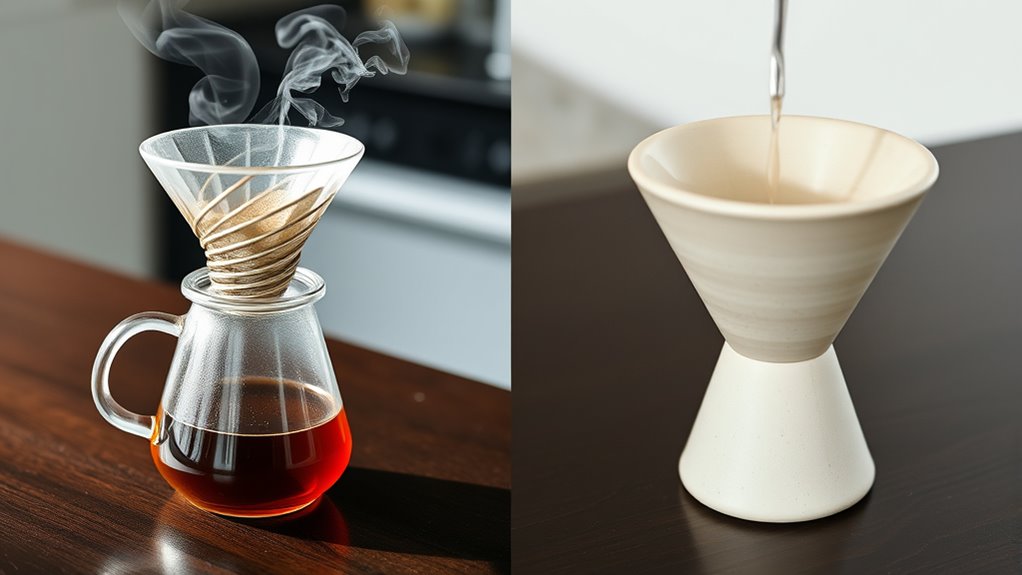

When comparing pour-over methods, you’ll notice variations in grind size, brewing time, and pouring technique, which all influence flavor and clarity. Finer grinds and slower pours tend to extract more complex flavors but can increase bitterness, while coarser grinds and faster pours produce lighter, brighter cups. Adjusting these factors helps tailor your brew to your taste. Stay with us to discover specific method differences and how to optimize your pour-over experience.

Get coffee and tea gear delivered free with Prime
- Fast, free delivery on millions of items
- Prime Video, Amazon Music and more included
- Member-only deals all year
Key Takeaways
- Different pour-over devices vary in water flow rate, affecting extraction time and flavor clarity.
- Changes in grind size and pouring technique are essential to optimize extraction and prevent over- or under-extraction.
- Variations like V60, Chemex, or Kalita differ in design, influencing brewing time and resulting flavor profiles.
- Adjusting pouring speed and pattern impacts contact time, extraction level, and overall coffee balance.
- Understanding these differences helps customize brewing methods for desired flavor, strength, and clarity.

Pour-over brewing has gained popularity among coffee enthusiasts for its ability to produce a clean, flavorful cup. When you’re aiming for the perfect pour-over, the grind size and brewing time play vital roles in shaping the final taste. Your grind size determines how quickly water passes through the coffee grounds, directly impacting extraction. A finer grind increases surface area, leading to a slower brew and more extraction, which can enhance flavor but also risk over-extraction if not carefully managed. Conversely, a coarser grind allows water to flow faster, reducing extraction and potentially resulting in a lighter, less intense cup. Finding the right grind size depends on your specific pour-over method, but generally, medium grind is a safe starting point for most pour-over devices.
Adjust grind size to control extraction and achieve your ideal pour-over flavor profile.
Once you’ve set your grind size, brewing time becomes the next essential factor. A longer brewing time allows water to extract more flavors from the coffee, often resulting in a richer, more complex profile. However, too long a brew can lead to over-extraction, making the coffee taste bitter or astringent. On the other hand, a shorter brewing time might produce a brighter, more acidic cup, but it could also mean under-extraction, leaving the coffee flat or weak. To optimize your brewing time, pay attention to how fast the water drips through your coffee bed, and adjust either your grind size or pouring technique accordingly. For instance, if your brew takes longer than four minutes, consider coarsening your grind to speed up the process. If it’s under two minutes, try a finer grind or slow down your pour to increase contact time.
Your pouring technique also influences brewing time and extraction. A slow, steady pour ensures even saturation of the grounds, giving the water enough contact time to extract desirable flavors without overdoing it. Rapid or uneven pouring can cause channeling, where water bypasses some grounds, leading to uneven extraction and inconsistent flavor. Experimenting with pouring style and timing helps you fine-tune the balance between grind size and brewing time. Remember, small adjustments can make a big difference. If your coffee tastes too sour, try increasing the brewing time or using a slightly finer grind. If it’s bitter, consider shortening the brew or coarsening the grind. Additionally, understanding the optimal grind size for your specific brewing method can greatly improve your results.
Ultimately, understanding how grind size and brewing time interact allows you to customize your pour-over brewing process for a consistently excellent cup. By paying close attention to these variables and making deliberate adjustments, you can master a pour-over method that highlights the nuanced flavors of your favorite beans.
As an affiliate, we earn on qualifying purchases.
Frequently Asked Questions
How Does Grind Size Impact Pour-Over Extraction?
You’ll notice that grind size greatly impacts pour-over extraction because it affects grind consistency and particle distribution. A finer grind increases surface area, speeding up extraction, but can cause over-extraction if too fine. Conversely, a coarser grind slows extraction, resulting in under-extracted, weak coffee. Maintaining a consistent grind size guarantees even particle distribution, which promotes uniform extraction and better flavor, giving you a more balanced, enjoyable cup.
What Are the Maintenance Needs for Different Pour-Over Devices?
You need to regularly clean your pour-over device to keep it functioning well. For most devices, you should rinse the filter basket and carafe after each use and do a deep clean weekly. Replace filters when they become clogged or worn out, typically every few weeks. Maintaining proper cleaning frequency and timely filter replacement guarantees ideal flavor extraction and prevents buildup that could affect your brew quality.
Can Pour-Over Brewing Be Scaled for Large Groups?
Yes, you can scale pour-over brewing for large groups by using multiple devices or larger drippers. This approach helps maintain brewing consistency and preserves coffee flavor profiles, ensuring each cup tastes as good as the last. To achieve uniform results, control variables like water temperature and pour rate across all brewers. While it requires effort, scaling pour-over brewing lets you serve high-quality coffee efficiently to bigger crowds.
What Are the Cost Differences Between Various Pour-Over Methods?
You’ll find that the financial implications of pour-over methods vary based on equipment affordability. Manual pour-over setups like drippers are generally low-cost, making them budget-friendly for home use. Conversely, high-end automated pour-over machines cost more upfront but can save time and effort during large-scale brewing. Consider your needs and volume; choosing the right method balances initial investment with ongoing costs, ensuring you get the best value for your money.
How Do Environmental Factors Influence Pour-Over Coffee Quality?
You’ll notice that environmental factors like water temperature and ambient humidity act as invisible puppeteers, guiding your coffee’s flavor. Too hot water, and you risk scalding delicate notes; too cold, and richness suffers. High humidity can make grounds clump, slowing extraction and dulling taste. By controlling your environment or adjusting your technique, you guarantee each pour-over brew sings with clarity, balance, and vibrant character.
Conclusion
As you explore pour-over methods, think of each as a unique brushstroke on your coffee canvas. Some pour smoothly like a gentle stream, while others cascade like a lively waterfall, shaping the flavor landscape. Understanding these differences lets you craft your perfect brew—a masterpiece of aroma and taste. So, embrace the variety, experiment boldly, and watch your coffee journey unfold into a vibrant mosaic of rich, personalized experiences.
Fall Picks
fall essentials
As an affiliate, we earn on qualifying purchases.