For brewing coffee, I’d start with the YDDZZM gooseneck kettle: its 1°F adjustments and narrow spout suit controlled pour-over better than a general-purpose immersion heater. The Chefman 1.8-liter kettle is my pick for larger batches and preset temperatures, while the 1800W controller-equipped immersion heater gives users who heat water in a bucket or small vessel more control than a basic heater. The main choice is between a kettle designed to heat and pour drinking water and an immersion heater that can warm water in a separate container. Capacity, temperature control, and safe handling matter more here than raw wattage alone.

Get coffee and tea gear delivered free with Prime
- Fast, free delivery on millions of items
- Prime Video, Amazon Music and more included
- Member-only deals all year
I ranked these options by how directly they support brewing, how much control they offer, and how well their design fits a typical coffee routine. The two kettles are the natural choices for cup-ready coffee; the bucket heaters are more portable or adaptable, but require extra care and are less convenient for pouring. The small dual-voltage heater is useful for travel, though its low wattage makes it a different tool from a kitchen kettle.
Complete the kit


Key Takeaways
- Best for pour-over precision: The YDDZZM gooseneck kettle offers a 104–212°F range in 1°F increments and a narrow spout, but its 0.9-liter capacity limits batch size.
- Best for larger household batches: The Chefman holds 1.8 liters and offers seven preset temperatures, though it lacks the gooseneck’s fine-grained adjustment.
- Best for controlled bucket heating: The 1800W immersion heater adds an LCD controller, anti-dry-burn protection, and automatic shutoff, but it is not a large-tank solution.
- Fastest listed heating power: The 2000W portable heater is aimed at warming bucket or tub volumes quickly, not pouring directly into a coffee brewer.
- Best travel scale: The dual-voltage 300W heater packs small and works with a separate container, but its low output is better for a cup than a brewing batch.




| water heaters for brewing | Power | Voltage |
|---|---|---|
| Gooseneck Electric Kettle | 1000 W | 120 V |
| Chefman Electric Glass Kettle | 1100 W | 120 V |
| Immersion Water Heater with Co | 1800 W | — |
| Portable Water Heater | 2000 W | — |
| 300W Dual-Voltage Portable Imm | 300 W | 110–120V and 220–240V |
More Details on Our Top Picks
Gooseneck Electric Kettle, Intelligent Temperature Control, Stainless Steel Inner, Quick Heating, for Pour Over Coffee, Brew Tea, Boil Hot Water, 1000W 0.9L Black
This is the most directly brewing-focused option in the group. Its gooseneck spout helps direct water over coffee grounds with more control than the Chefman’s standard kettle shape, and the LCD lets you select a temperature from 104°F to 212°F in 1°F increments. That combination is useful for repeatable pour-over routines, where both water temperature and the way it is poured can affect the brewing process.
The tradeoff is volume. At 0.9 liters, it holds half the Chefman’s listed 1.8-liter capacity, so I’d favor this model for one or two smaller brews rather than serving a group. Its 1000W rating is also lower than either high-power immersion heater, though kettle wattage alone does not tell me exactly how long a particular batch will take. The 24-hour keep-warm feature can help when brewing in stages, but the plastic wood-look handle may feel less substantial than the steel interior. Compared with the immersion models, it is much better suited to directly preparing coffee water; compared with the Chefman, it gives up capacity for pour control and finer temperature selection.
I place it first because its design and controls line up closely with coffee brewing rather than general water heating. Buyers should still verify that the small capacity suits their brewer and serving size.
Pros:- Temperature control adjusts in 1°F steps across 104–212°F.
- Gooseneck spout supports a more directed pour for coffee.
- 304 stainless steel interior and LCD display.
- 24-hour keep-warm function and stated automatic shutoff and anti-dry protection.
Cons:- 0.9-liter capacity is smaller than the Chefman’s 1.8 liters.
- Plastic wood-look handle may feel less premium.
- A 1000W rating may be less appealing to buyers prioritizing higher listed power.
Best for: Pour-over coffee drinkers who want fine temperature adjustment and a directed pour for smaller batches.
Not ideal for: Anyone brewing for a group, needing a large reservoir, or expecting a premium-feeling all-metal exterior and handle.
- Capacity:0.9 L
- Power:1000 W
- Voltage:120 V
- Temperature range:104°F–212°F, in 1°F increments
- Interior:Food-grade 304 stainless steel
- Display:LCD digital display
- Keep warm:Up to 24 hours
- Safety:Anti-dry protection and automatic shutoff
Our verdict“I’d choose this gooseneck kettle for precise, small-batch pour-over, provided its 0.9-liter capacity fits my coffee routine.”
Chefman Electric Glass Kettle with Temperature Control and Removable Tea Infuser, 1.8 L
The Chefman is the practical alternative to the compact gooseneck: its 1.8-liter capacity can cover more cups per fill, and seven presets from 160°F to 212°F make it easy to select a common hot-water setting without dialing in a custom number. For households that alternate between coffee and tea, that broad usefulness may matter more than the YDDZZM’s finer temperature increments.
Its glass-and-stainless construction, removable lid, and cordless kettle design make filling and serving familiar. The removable infuser is a bonus for loose-leaf tea, though it does not improve coffee brewing itself. Coffee drinkers who want to control the stream for pour-over may find the standard kettle less precise than the YDDZZM’s gooseneck. Its lowest preset is 160°F, so it also offers less flexibility at the lower end than the YDDZZM’s 104°F minimum. Compared with the 1800W immersion heater, it is a more natural kitchen appliance for heating water that will go straight into a brewer, but the listed 1100W power is below the immersion models’ 1800W and 2000W ratings.
Automatic shutoff and boil-dry protection add useful safeguards, but the kettle must sit on its powered base to heat. I’d put it ahead of the immersion options for everyday household brewing because capacity and straightforward pouring matter more to most kitchen routines than bucket-heater portability.
Pros:- 1.8-liter capacity supports more water per fill than the 0.9-liter gooseneck.
- Seven temperature presets cover 160–212°F.
- Removable lid eases filling and cleaning; cordless kettle lifts from its swivel base.
- Automatic shutoff and boil-dry protection.
Cons:- Standard spout provides less pour control than the YDDZZM gooseneck.
- Lowest preset is 160°F, less flexible than the YDDZZM’s range.
- Heating requires the kettle to sit on its plugged-in base.
Best for: Households that brew several cups at once and want one kettle for coffee, tea, and general hot water.
Not ideal for: Pour-over brewers who want a narrow, controlled stream or users who need temperatures below 160°F.
- Capacity:1.8 L
- Power:1100 W
- Voltage:120 V
- Temperature presets:7
- Temperature range:160–212°F
- Materials:Glass and stainless steel
- Infuser:Removable tea infuser
- Safety and base:Automatic shutoff, boil-dry protection, 360-degree swivel base
Our verdict“I’d pick the Chefman over the gooseneck when batch size and preset convenience matter more than fine temperature control.”
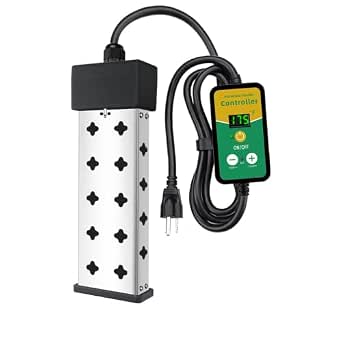
Immersion Water Heater with Controller, 1800W Portable Bucket Heater
Among the immersion choices, this model offers the clearest route to a chosen heating target. The LCD controller and stated temperature limit of 175°F give more feedback than the 2000W portable heater, whose description mentions a digital thermometer but not a controller or an adjustable temperature range. Anti-dry-burn protection and automatic shutoff are also stated, which adds safeguards for a device that heats in a separate vessel.
For brewing, the advantage is control over water warmed in a compatible bucket or small container; the disadvantage is that it remains an immersion heater, not a pour-ready kettle. I would still need a suitable vessel and a safe way to transfer the water to a coffee brewer. The 1800W rating is substantial, but the product is explicitly limited to small water volumes and not suitable for large tanks. That makes it less flexible for large-batch heating than a buyer might infer from the wattage. Compared with the Chefman, it offers an LCD-controlled target but lacks the kettle’s integrated filling, pouring, and 1.8-liter kitchen format. Compared with the 300W travel heater, it is much more oriented toward heating a larger vessel, but less convenient to pack and use for one cup.
The heavy-duty 14AWG cord and 304 stainless steel construction are practical details, yet proper use matters: the heater must be used according to its instructions and kept in the required water conditions. I rank it as the strongest immersion pick, not as a replacement for a dedicated coffee kettle.
Pros:- LCD controller provides real-time temperature feedback.
- Temperature control reaches up to 175°F.
- Anti-dry-burn protection and automatic shutoff are stated.
- 304 stainless steel build and heavy-duty 14AWG cord.
Cons:- Not suitable for large tanks or large water volumes.
- Requires a separate compatible container and careful water transfer for brewing.
- Needs an electrical outlet and proper handling.
Best for: Users who already heat water in buckets or small containers and want an immersion heater with temperature feedback and safety features.
Not ideal for: Coffee drinkers who want an integrated kettle, direct pour control, or a heater for large tanks.
- Power:1800 W
- Temperature limit:Up to 175°F
- Material:304 stainless steel
- Cord:14AWG heavy-duty
- Display:LCD
- Safety features:Anti-dry-burn and automatic shutoff
- Listed applications:Bathtubs, buckets, and small containers
- Volume suitability:Small volumes; not for large tanks
Our verdict“I’d choose this as the most controlled bucket-heating option, but not if I want a simple kettle for making coffee.”
Portable Water Heater, Immersion Heater for Bucket, Rapid Heating
This 2000W model is the highest-powered heater in the lineup, and its description says it can heat five gallons of water in minutes. That makes it the most relevant choice here for someone who prioritizes warming a bucket-sized volume rather than preparing a small coffee kettle. The digital thermometer provides a temperature reading, while the stainless steel guard helps prevent contact with the heating element. It also has an auto shutoff feature.
Those attributes do not make it a coffee kettle. The heater is limited to buckets or tubs, and the description requires full submersion before use. For coffee, the user must first heat water in an appropriate container and then transfer it to the brewer or a pouring vessel. Unlike the 1800W controller model, the supplied details do not specify an adjustable temperature range or describe a controller that maintains a chosen target. The thermometer is useful for checking temperature, but it is not the same as precise preset or incremental control. Compared with the 300W travel heater, this one is aimed at much more water and higher listed power, while sacrificing the travel model’s dual-voltage support and compact cup-scale use.
I place it below the controller-equipped immersion heater for brewing because temperature selection is a bigger advantage than a modest wattage difference when preparing coffee. Its fast-heating claim and five-gallon capacity description may suit bucket use, but I would skip it if my main goal were a convenient, repeatable cup of coffee. The stated safety features do not remove the need to follow instructions carefully.
Pros:- Highest listed power in this roundup at 2000W.
- Description states it can heat five gallons of water in minutes.
- Digital thermometer allows real-time temperature monitoring.
- Auto shutoff and stainless steel guard are included.
Cons:- Requires full submersion before use and careful handling.
- Limited to heating water in buckets or tubs.
- No adjustable temperature range or target-hold control is specified.
Best for: Buyers who need a high-power portable heater for bucket or tub water and can manage safe heating and transfer.
Not ideal for: Coffee drinkers seeking a direct-pour kettle, fine temperature control, or an appliance designed specifically for small brewing volumes.
- Power:2000 W
- Described capacity:Heats 5 gallons of water
- Material:304 stainless steel
- Temperature feedback:Digital thermometer
- Safety feature:Automatic shutoff
- Element protection:Stainless steel guard
- Portability:Compact and lightweight
- Use requirement:Full submersion before operation
Our verdict“I’d choose this for higher-power bucket heating, but I would favor a kettle or the 1800W controller model for more deliberate coffee-water preparation.”
300W Dual-Voltage Portable Immersion Water Heater
This is the smallest-scale option in the group. At 300W, it is intended to warm water or other beverages in a cup or container, not to heat a household-sized kettle quickly. Its useful distinction is travel flexibility: it supports both 110–120V and 220–240V and includes a universal power adapter and storage pouch. For someone who wants to warm a single drink while away from home, that kit is more relevant than the 1.8-liter Chefman or the 2000W bucket heater.
For coffee brewing, the limitations are pronounced. The heater requires a separate glass, ceramic, or stainless steel container, and the description does not provide a temperature controller or digital readout. That makes it less suited to repeatable brewing than either kettle, especially the YDDZZM with 1°F adjustments. Its stainless steel heating element is a sensible material choice, but the heater must cool before handling, which adds a pause to packing or changing containers. Compared with the 1800W immersion model, it trades power and temperature feedback for a lighter travel-oriented setup. Compared with the YDDZZM, it may be easier to carry but does not offer an integrated kettle, gooseneck pour, or stated temperature range.
I rank it fifth because travel compatibility cannot make up for the extra steps and limited control in a brewing routine. It remains a distinct pick for a person who values dual-voltage operation and only needs to warm a small amount. I would not select it as my primary home coffee heater.
Pros:- Dual-voltage support covers 110–120V and 220–240V.
- Compact travel setup includes a storage pouch and universal power adapter.
- 304 stainless steel heating element.
- Can warm water or other beverages in a compatible cup or container.
Cons:- 300W output is aimed at small amounts rather than kettle-sized batches.
- Requires a separate glass, ceramic, or stainless steel container.
- No temperature control or display is specified, and the element must cool before handling.
Best for: Travelers who need a compact, dual-voltage heater for warming a small drink in a compatible container.
Not ideal for: Home coffee brewers who want a fast multi-cup batch, controlled brewing temperatures, or a kettle that pours directly.
- Power:300 W
- Voltage:110–120V and 220–240V
- Heating element:304 stainless steel
- Included:Heater, storage pouch, universal power adapter
- Pack count:1
- Color:White
- Container requirement:Separate glass, ceramic, or stainless steel vessel
- Handling note:Allow the heating element to cool before handling
Our verdict“I’d reserve this for travel and small drinks, not choose it for a main coffee-brewing setup.”

How We Picked
I ranked these five products around the practical demands of brewing coffee and other hot drinks: reaching a useful temperature, controlling heat, handling the amount of water a brewer needs, and pouring or transferring that water without awkward workarounds. A kettle gets an advantage for coffee because it heats water in a vessel made for kitchen use and is straightforward to pour. A gooseneck spout and fine temperature steps can help with pour-over, while preset temperatures and more capacity suit varied household use.
I treated immersion heaters as a separate category rather than pretending they work like kettles. Their strengths are portability and the ability to heat water in a bucket or other compatible container. Their drawbacks for brewing are equally relevant: the user must supply the container, observe the product’s use requirements, and transfer or pour the heated water safely. Wattage gives some indication of heating power, but the supplied descriptions do not establish a guaranteed heating time for a given brewing volume, so I do not rank by time claims alone.
My order favors the products whose features most directly support a repeatable coffee routine, followed by options that fit specialized container-based or travel use. I also weighed capacity, temperature range, included controls, and stated safety features. None of these products is presented as a brewing appliance for large commercial volumes; the immersion models have stated limits, and both kettles are household-sized. I recommend checking the manufacturer’s instructions and using each heater only with compatible vessels and conditions.
Factors to Consider When Choosing Water Heaters For Brewing
For brewing, the best water heater is not automatically the one with the highest wattage. I’d match the appliance to the brewing method, amount of water, and degree of temperature control I actually need. These five products divide into kettles for direct kitchen use and immersion heaters for warming water in a separate vessel.
Choose a kettle or an immersion heater
A kettle is generally the more direct option for coffee: fill it, heat the water, and pour into a brewer. The YDDZZM adds a gooseneck for a directed stream, while the Chefman emphasizes capacity and presets. An immersion heater can be useful when a bucket or other container is part of the task, but brewing adds another step: you need a safe way to transfer the hot water. I would not treat an immersion heater as interchangeable with a purpose-built kettle simply because both heat water.
Match temperature control to the brew
The YDDZZM offers the most detailed specified control, with 1°F adjustments from 104°F to 212°F. That is useful if I want to repeat a particular coffee-water setting or use different temperatures for different drinks. The Chefman provides seven presets from 160°F to 212°F, which is easier for routine selections but less adjustable. The 1800W immersion heater displays and controls temperature up to 175°F; the 2000W model includes a thermometer but does not specify a target-setting range. The 300W travel heater lists no temperature display or controller.
Think about batch size, not just power
The Chefman’s 1.8-liter capacity is the largest clearly stated kettle capacity, making it a better fit for several cups than the YDDZZM’s 0.9 liters. The travel heater is described for a cup or container, while the controlled immersion model is limited to small volumes and the 2000W heater is described for bucket or tub use. Higher wattage can be attractive when heating a larger amount, but product descriptions do not provide a consistent, independently comparable heating-time test. I would use stated capacity and intended vessel size as the main guide.
Treat immersion-heater safety as part of the choice
Immersion heaters require attention to placement, water coverage, and handling. The 2000W model specifically requires full submersion before use, and the 300W model’s element must cool before handling. The 1800W model lists anti-dry-burn and automatic shutoff; the 2000W model lists automatic shutoff and a guard. Those features are useful, but they are not a substitute for following the product instructions and using a compatible vessel. If I want fewer steps around hot water, I would choose a kettle.
Prioritize pour control for pour-over
A narrow spout gives the YDDZZM a clear role for pour-over coffee: it is designed to direct the stream more carefully than the Chefman’s general kettle form. That does not make it the better choice for every brew. For drip machines, French presses, or several servings, the larger Chefman may be more convenient. Neither immersion heater offers an integrated pouring spout, so I would choose one only when portability or container-based heating outweighs the need for a controlled pour.
Frequently Asked Questions
Which water heater in this roundup is best for pour-over coffee?
I’d choose the YDDZZM gooseneck kettle for pour-over because its narrow spout supports a directed stream and its temperature adjusts in 1°F increments. Its 0.9-liter capacity is the main constraint, so it suits smaller batches better than serving a group. The Chefman holds more water, but its standard kettle shape offers less pour control.
Is an immersion heater suitable for brewing coffee?
An immersion heater can warm water for coffee, but it is less direct than a kettle. You need a compatible container, must follow the heater’s use instructions, and still need to transfer the hot water safely to the brewer. The 1800W controller model gives more temperature feedback than the other immersion options here, while neither bucket heater has the integrated pouring design of the kettles.
Which option holds the most water?
The Chefman has the largest clearly listed kettle capacity at 1.8 liters, compared with 0.9 liters for the YDDZZM. The 2000W immersion heater is described as capable of heating five gallons, but that is a bucket-heating use case rather than a kettle reservoir for pouring coffee. The 1800W immersion heater is specifically described as unsuitable for large tanks.
Which model offers the most precise temperature adjustment?
The YDDZZM provides the most detailed specified adjustment, with an LCD and 1°F increments across 104–212°F. The Chefman uses seven presets between 160°F and 212°F, and the 1800W immersion heater has an LCD controller with a stated maximum of 175°F. The 2000W heater has a thermometer, while the 300W travel heater does not list temperature-control features.
Can I use these products for large-scale brewing?
These are household or portable options, not specified commercial brewing systems. The Chefman’s 1.8-liter capacity and the YDDZZM’s 0.9-liter capacity suit smaller kitchen batches, while the controlled 1800W immersion heater is limited to small volumes. The 2000W model is described for bucket or tub heating, but that does not make it a dedicated large-batch brewing kettle; check the product instructions and vessel requirements before use.
Conclusion
For my coffee-first recommendation, I’d choose the YDDZZM gooseneck kettle when controlled pour-over and fine temperature changes matter more than batch size. If I needed water for several cups or a mix of coffee and tea, I’d pick the Chefman 1.8-liter kettle for its larger capacity and easy preset operation. Buyers committed to bucket heating should look at the 1800W controller-equipped immersion heater for temperature feedback, while the 2000W model better fits higher-power bucket use without specified target control. I’d reserve the 300W dual-voltage heater for travelers warming small amounts in a separate container. The right choice comes down to whether I want a coffee kettle, a versatile household kettle, or a portable immersion heater—and how much temperature and pouring control my brewing routine needs.