When searching for hearing aids, not amplifiers, focus on devices designed for hearing loss, with controllable sound processing and a fit you can manage—not simply louder sound. My best overall pick is the Not Amplifiers True Professional Hearing Aids, which combine a behind-the-ear design, 16-channel DSP, noise cancellation, and a charging case. The Vivtone Supermini stands out for a discreet in-ear form, while the OTC model with two environment modes offers a more direct way to adjust for different settings. The main tradeoffs are fit and discretion versus ease of handling, along with simpler controls versus more sound adjustments. Read on for the full comparison, selection criteria, and guidance on when an OTC device may not be the right choice.

Get coffee and tea gear delivered free with Prime
- Fast, free delivery on millions of items
- Prime Video, Amazon Music and more included
- Member-only deals all year
Complete the kit

Key Takeaways
- The best overall choice favors usable design over feature-count claims: the Not Amplifiers True Professional model pairs 16-channel DSP with a familiar BTE shape and charging case.
- Compact in-ear options trade handling ease for discretion: the Vivtone Supermini and the small True 11-channel model may appeal to buyers who want less visible devices, but small controls and insertion can be harder for some users.
- More channels do not by themselves prove better hearing support: several options advertise 16-channel processing, so fit, adjustment support, and return terms matter when comparing similar claims.
- Battery claims need context: the Karthus listing advertises up to 100 hours, while another OTC option lists 80+ hours; check whether those figures include charging-case capacity or refer to use between charges.
- Several listings provide limited model detail: where product names do not spell out controls, fitting help, or service support, buyers should verify those details before choosing based on noise-cancellation or invisibility language.





| hearing aids not amplifier | Battery life | Channels | Charging time |
|---|---|---|---|
| BTE Rechargeable Hearing Aids | — | 16 | — |
| Flaygo Rechargeable Hearing Ai | — | 16-channel digital chip | — |
| Flaygo Rechargeable Hearing Ai | Up to 16 hours per charge | 16 | 1–2 hours |
| True Hearing Aids Invisible 16 | Up to 18 hours | 16 | — |
| Not Amplifiers True Profession | — | 16 | — |
| OTC Hearing Aids for Seniors & | 80+ hours | — | 2 hours |
| Vivtone Supermini Digital Rech | Over 16 hours | — | 2 hours |
| Karthus Rechargeable Hearing A | Up to 30 hours per charge; up to 100 hours with charging case | — | 15 minutes for hours of support |
| Vivtone Supermini Digital Hear | Over 16 hours per charge | — | 2 hours |
| Audien Atom One OTC Hearing Ai | Up to 24 hours | — | About 3 hours |
| Rechargeable Hearing Aids for | 16 hours per charge | — | 1–2 hours |
| Bigprot Rechargeable OTC Heari | — | — | — |
| True Hearing Aids for Seniors | — | 11 | — |
| Avicill Rechargeable BTE Heari | — | 16 | — |
More Details on Our Top Picks
BTE Rechargeable Hearing Aids for Seniors with Charging Case, 16-Channel Noise Cancelling, Lightweight & Easy to Use
I’d put this BTE model on the shortlist for buyers who want a familiar behind-the-ear fit and a charging case that can extend use between wall charges. Its 16-channel processing and three noise-reduction modes are intended to help speech stand out across changing environments, while auto-on/off keeps daily operation simple. The stated battery figure needs a close read: it describes 20 hours including three hours per charge and four case recharges, rather than 20 hours from a single charge. Compared with the Flaygo RM, which specifies USB-C charging and up to 80 hours with its case, this model gives less charging detail but offers three listening modes instead of four fixed volume levels. Expect some setup and listening adjustment, and don’t assume smartphone compatibility—the supplied details do not establish it.
Pros:- Three noise-reduction modes offer choices for different listening environments.
- Magnetic charging case is designed to provide four additional recharges.
- Auto-on/off reduces the number of manual steps in everyday use.
- Lightweight BTE hooks are intended for comfortable extended wear.
Cons:- The stated 20-hour figure includes case recharges, while each charge is listed as three hours.
- No smartphone compatibility or companion-app details are provided.
- The product description says some adjustment may be needed for a comfortable, effective setup.
Best for: Seniors who prefer an easy-to-handle BTE design and want a charging case for errands or day trips.
Not ideal for: Buyers who need confirmed phone connectivity, extensive app controls, or clearly specified all-day runtime from one charge.
- Style:Behind-the-ear with ergonomic ear hooks
- Channels:16
- Noise reduction modes:3
- Battery claim:20 hours including 3 hours per charge and 4 case recharges
- Charging:Magnetic charging case
- Controls:Auto-on/off
Our verdict“Choose this BTE pair if simple controls and a case with several recharges matter more than confirmed phone support or a long single-charge runtime.”
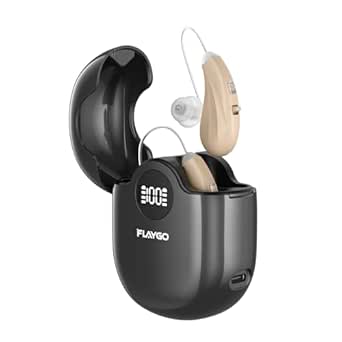
Flaygo Rechargeable Hearing Aids with Noise Reduction, Beige
The Flaygo RM is the clearest fit here for someone who wants a conventional BTE aid with simple button control rather than multiple listening modes. Its four volume levels make adjustment easy to understand, while whistling suppression targets a common annoyance with close-fitting hearing devices. The listing also names smartphone, tablet, and television compatibility, but does not explain whether that means direct audio streaming, so I would verify the connection method before buying for that purpose. Compared with the BTE Rechargeable Hearing Aids with three noise-reduction modes, the Flaygo offers more explicit volume steps and USB-C charging, but fewer ways to select an environment. Its up-to-80-hour case claim is appealing, though it is not the same as 80 hours on one charge; the four-level control may feel limiting to listeners who need finer adjustment.
Pros:- Lightweight 3.5 g design may suit buyers seeking a less noticeable BTE fit.
- Four volume levels provide simple, direct adjustment.
- Noise reduction and whistling suppression address two common listening concerns.
- USB-C charging and a case rated for up to 80 hours of listening add charging flexibility.
Cons:- Four volume levels may not provide enough fine adjustment for some listeners.
- The BTE fit may not suit people who prefer an in-ear device.
- Listed device compatibility does not specify whether direct audio streaming is supported.
Best for: First-time BTE buyers who want a lightweight beige device, uncomplicated buttons, and USB-C charging.
Not ideal for: Listeners who need detailed sound customization, more than four volume settings, or verified direct streaming to a phone or TV.
- Brand and model:Flaygo RM; model number GM-362T
- Fit:Behind-the-ear
- Weight:3.5 g
- Channels:16-channel digital chip
- Volume levels:4
- Charging:USB-C; 2-hour charge
- Listening time:Up to 80 hours with charging case
- Listed compatible devices:Smartphone, tablet, television
Our verdict“Pick the Flaygo RM for simple BTE volume control and USB-C charging, but skip it if you need precise tuning or confirmed streaming.”
Flaygo Rechargeable Hearing Aid for Seniors with 16-Channel Digital Chips and Noise Cancellation
Among these five, this Flaygo is the option for buyers who put a small, discreet in-ear profile ahead of visible BTE hardware. The listing describes an ergonomic curve and medical-grade silicone, aiming for a close fit, and claims up to 16 hours per charge with a portable case. That makes it a different proposition from the Flaygo RM: the RM has an explicit BTE fit, USB-C charging, and four volume levels, while this model prioritizes concealment and gives less control detail. The 16-channel processing and noise reduction are stated, but the description does not provide mode counts or a clear method for manual adjustment. Its standby claim is seven days, not seven days of continuous listening, and the 15-second auto-on delay may frustrate buyers who expect immediate activation. Waterproof protection is also unspecified.
Pros:- Super-mini in-ear design is aimed at buyers who want a discreet appearance.
- Medical-grade silicone and an ergonomic curve are intended to support comfortable wear.
- 16-channel processing with noise reduction is specified.
- Portable case supports charging away from a wall outlet.
Cons:- Auto-on may take 15 seconds, slowing use when the device is first put in.
- Waterproof features are not specified.
- The listing gives little information about adjustment controls or listening modes.
- Up to 16 hours per charge may require more frequent charging than the Flaygo RM’s case-based claim.
Best for: Adults who strongly prefer a low-visibility in-ear style and are comfortable with limited published control and protection details.
Not ideal for: Buyers who want a visible, easy-to-handle BTE device, immediate auto-on, or stated waterproof protection.
- Channels:16
- Battery life:Up to 16 hours per charge
- Charging time:1–2 hours
- Standby time:Up to 7 days
- Material:Medical-grade silicone
- Design:Super-mini, ergonomic in-ear curve
- Activation:Automatic on/off; activation may take 15 seconds
Our verdict“Choose this Flaygo if a discreet in-ear profile is your priority, but favor the Flaygo RM if clear, simple controls matter more.”
True Hearing Aids Invisible 16 Channels Digital Rechargeable Hearing Aids for Seniors with Noise Cancellation and Charging Box
This True model stands out for a 1 g in-ear design paired with a stated 18-hour battery life, making it a plausible choice for buyers who dislike the visible hooks of BTE aids. It also specifies 16 channels and active noise cancellation, though the listing does not explain how the cancellation is adjusted or how the aids are fitted to an individual hearing profile. Compared with the super-mini Flaygo, this product gives a clearer battery-life figure and identifies button control, while the Flaygo provides more fit-material detail and a seven-day standby claim. The product information has a notable inconsistency: it describes the aids as rechargeable but also says included batteries may need replacement. I would clarify the power system before purchase. Limited software-update information also makes this a less convincing pick for buyers seeking long-term digital support.
Pros:- Listed weight of 1 g supports a particularly lightweight in-ear profile.
- 18-hour battery-life claim is more explicit than the Flaygo super-mini’s general standby information.
- 16 channels and active noise cancellation are specified.
- Button control offers a direct alternative to app-based adjustment.
Cons:- Product details conflict by describing the aids as rechargeable while also mentioning batteries that may need replacement.
- Software-update support is not specified.
- No fitting or adjustment process is described beyond button control.
- Black in-ear styling may be less discreet for some wearers than a skin-toned option.
Best for: Buyers who want a very lightweight in-ear aid, straightforward button operation, and a stated 18-hour battery life.
Not ideal for: People who need clear confirmation of the charging and battery system, software support, or a documented personalized fitting process.
- Channels:16
- Battery life:Up to 18 hours
- Power:Listed as rechargeable; product details also mention included replaceable batteries
- Control:Button
- Noise cancellation:Active noise cancellation
- Fit:In-ear
- Color:Black
- Weight:1 g
Our verdict“Consider this True model for its light in-ear form and stated runtime only after confirming how its rechargeable and replaceable-battery details apply.”
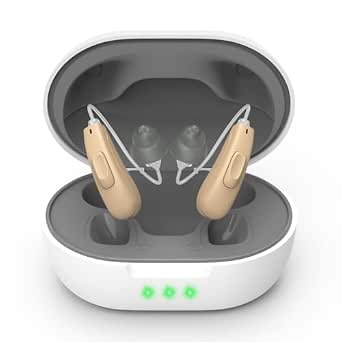
Not Amplifiers True Professional Hearing Aids for Seniors with Hearing Loss – 16-Channel DSP Noise Cancellation, OTC Rechargeable BTE Hearing Aids with Charging Case
This Not Amplifiers model is the most clearly positioned as an over-the-counter BTE hearing aid in this group, with 16-channel DSP noise cancellation and a rechargeable case. That makes it a reasonable starting point for adults seeking a self-directed option rather than an in-ear design such as the True 16-channel model. The short product data, however, leaves several practical questions unanswered: there is no stated runtime, charging time, control layout, or level of user adjustment. Compared with the BTE Rechargeable Hearing Aids with three noise-reduction modes, this pick makes a stronger OTC and DSP claim but gives less concrete operating detail. The lightweight, compact design may help with extended wear, yet the description acknowledges that initial fit adjustment may be needed. Buyers who need individualized tuning or clinical fitting should not treat self-adjustment as a substitute for professional guidance.
Pros:- Clearly identified as an OTC BTE hearing aid.
- 16-channel DSP noise cancellation is specified.
- Rechargeable case is included for portable power.
- Lightweight, compact design is intended for comfortable daily wear.
Cons:- Battery runtime and charging time are not provided.
- Control details and adjustment range are not specified.
- Customization without professional help may be limited.
- Initial fit adjustment may be needed for comfort.
Best for: Adults with hearing loss who want a rechargeable OTC BTE option and are comfortable handling initial fit and adjustment themselves.
Not ideal for: Buyers who need a stated battery runtime, detailed volume or mode controls, extensive customization, or professional fitting.
- Type:OTC behind-the-ear hearing aids
- Channels:16
- Noise reduction:DSP noise cancellation
- Power:Rechargeable
- Charging:Charging case
- Design:Lightweight and compact
Our verdict“Choose this as a self-directed OTC BTE starting point if its basic feature set fits your needs, but look elsewhere for clear runtime and adjustment details.”
OTC Hearing Aids for Seniors & Adults, Rechargeable with Noise Cancelling & Clear Sound, 16-Channel Digital DSP, 2 Environment Modes, 80+ Hour Battery Life, Comfort-Fit, Black
For buyers who want digital hearing aids without frequent charging, this model’s 80+ hours of stated battery life make it stand apart from the Vivtone Supermini models, which offer over 16 hours per charge. Its 16-channel DSP, noise reduction, and feedback cancellation are aimed at making everyday listening less harsh, while two environment modes provide a simple way to adapt between settings. The two-hour charging time also keeps downtime relatively short. The tradeoff is a less tailored control setup than the Audien Atom One’s separate volume and frequency dials, and two modes may not suit people who want finer adjustments across varied environments. Fit can take some trial and adjustment, and the product data does not specify water or sweat resistance.
Pros:- Stated 80+ hour battery life reduces how often charging is needed.
- 16-channel digital processing with noise reduction and feedback cancellation.
- Two environment modes offer a basic way to adjust for different listening settings.
- Two-hour charging time limits time out of use.
Cons:- Only two environment modes, with less adjustment flexibility than separate volume and frequency controls.
- May take trial and adjustment to find a comfortable fit.
- No waterproof or sweat-resistance information is provided.
Best for: Adults seeking rechargeable OTC hearing aids for long daily wear who prefer fewer charging interruptions to detailed manual sound controls.
Not ideal for: People who need finely adjustable frequency controls, water-resistance details, or a professional fitting rather than an OTC device.
- Digital channels:16
- Battery life:80+ hours
- Charging time:2 hours
- Environment modes:2
- Color:Black
- Device type:Rechargeable OTC hearing aids
Our verdict“Choose this model if long stated battery life matters more to you than fine-grained sound controls or a clearly documented water-resistant design.”
Vivtone Supermini Digital Rechargeable Hearing Aids, 16-Channel Sound Processing, Auto-On/Off, Pair
The Vivtone Supermini is the fit-focused choice in this group: its small ergonomic design and four earbud sizes give buyers more ways to find a secure, less conspicuous fit than the behind-ear Karthus model. It also uses 16-channel sound processing, with general and noisy-environment modes, so it is presented as a digital hearing aid rather than a simple volume booster. Auto-on/off and memory functions reduce routine button work. The main compromise is runtime: over 16 hours per charge is enough for a day for many people, but it falls well short of the 80+ hours stated for the first product in this batch. Its OTC format also lacks a professional fitting, so choosing ear tips and allowing time to adjust remain part of the process.
Pros:- Supermini ergonomic design aims for a discreet in-ear fit.
- Four earbud sizes allow more fit adjustment than a single-size setup.
- 16-channel processing and two listening modes support digital sound adjustment.
- Auto-on/off and memory functions simplify regular use.
Cons:- Over 16 hours of stated use means daily charging for continuous day-to-day wear.
- OTC design does not include professional fitting.
- No specific water-resistance rating is supplied.
Best for: Adults who prioritize a discreet in-ear profile and want multiple earbud sizes to help find a comfortable fit.
Not ideal for: People who want several days of use between charges or need a clinician-fitted device and individualized programming.
- Digital channels:16
- Battery life:Over 16 hours
- Charging time:2 hours
- Standby power:Around 1 week
- Listening modes:General and noisy environment
- Earbud sizes:X-small, small, medium, and large
- Controls and memory:Auto-on/off and memory functions
Our verdict“Pick the Vivtone Supermini if a small, customizable in-ear fit matters more than the longer battery claims of the first product in this batch.”
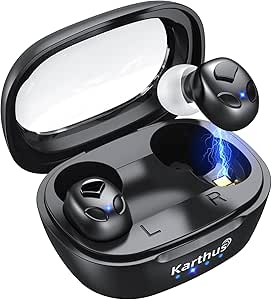
Karthus Rechargeable Hearing Aids for Seniors, Noise Cancelling, Invisible, 100H Battery Life, 7 Volume Levels, One-Button Operation, Gray Silver
Karthus puts ease of operation ahead of a tiny in-ear profile or detailed tuning. Its one-button operation and seven volume levels offer a straightforward approach for seniors who would rather avoid separate dials like those on the Audien Atom One. The behind-ear design with soft tulip tips may also feel easier to handle than Vivtone’s supermini style. Battery claims need a close read: the data states up to 30 hours per charge and 100 hours with the case, not 100 hours from one charge. Quiet and noise modes provide a basic environmental choice, but this is described for mild to moderate hearing loss and offers no Bluetooth connectivity. It suits buyers who value uncomplicated daily use, though it gives up wireless features and more precise fitting options.
Pros:- One-button operation is simpler than managing separate adjustment dials.
- Seven volume levels provide more steps than a basic two-level control scheme.
- Behind-ear design and soft tulip tips are intended for extended wear.
- Charging case is stated to provide up to 100 hours of combined battery support.
Cons:- Single-charge battery life is stated as up to 30 hours; 100 hours includes the charging case.
- No Bluetooth or wireless connectivity is listed.
- Product is specified for mild to moderate hearing loss.
Best for: Seniors with mild to moderate hearing loss who want physical, one-button operation and a behind-ear style rather than tiny in-ear controls.
Not ideal for: Buyers seeking Bluetooth, a single-charge runtime near 100 hours, or support for hearing loss beyond the stated mild-to-moderate range.
- Design:Behind-ear with soft tulip ear tips
- Battery life:Up to 30 hours per charge; up to 100 hours with charging case
- Charging time:15 minutes for hours of support
- Volume levels:7
- Operation:One-button
- Modes:Quiet Mode and Noise Mode
- Color:Gray Silver
- Stated hearing-loss support:Mild to moderate
Our verdict“Choose Karthus if simple one-button use and a behind-ear fit matter more than Bluetooth or Vivtone’s smaller in-ear design.”
Vivtone Supermini Digital Hearing Aids, Rechargeable, 16-Channel Sound Processing, Auto-On/Off, Pair
This Vivtone Supermini shares the first Vivtone’s core proposition—16-channel processing, a discreet fit, and over 16 hours of runtime—but its listing specifically highlights auto-on/off, memory, and multiple environment modes. Those automatic functions make it a reasonable fit for people who want fewer routine steps than the Audien Atom One, which relies on manual volume and frequency dials. Multiple earbud sizes also give it a fit advantage over models whose supplied data does not name tip options. The tradeoff is that its small design may require an initial fit and mode adjustment, and its daily charging schedule is less forgiving than the first product’s stated 80+ hours. The listing does not give a detailed mode count or name each environment setting, so buyers wanting exact control options have less information.
Pros:- 16-channel sound processing is designed for digital sound adjustment and noise reduction.
- Auto-on/off and memory functions reduce routine manual operation.
- Multiple earbud sizes support a more customizable fit.
- Over 16 hours of stated use can cover a typical day for many wearers.
Cons:- Over 16 hours per charge means regular daily charging.
- Initial adjustment to fit and environment modes may take time.
- The listing does not specify the number or exact names of its environment modes.
Best for: Adults who want a discreet rechargeable hearing aid with automatic power behavior and are comfortable charging it every day.
Not ideal for: People who prefer manual frequency tuning, need multi-day use between charges, or want detailed specifications for each listening mode.
- Digital channels:16
- Battery life:Over 16 hours per charge
- Charging time:2 hours
- Standby power:Approximately 1 week
- Design:Invisibly small, custom-fit design
- Features:Auto-on/off, noise reduction, and multiple environment modes
- Earbud fit:Multiple earbud sizes
Our verdict“Pick this Vivtone if automatic operation and a small, adjustable fit appeal more than the first product’s longer stated battery life.”
Audien Atom One OTC Hearing Aids
Unlike the DSP-focused Vivtone models, the Audien Atom One gives users separate analog volume and frequency dials. That makes it the clearest choice here for someone who wants direct, physical adjustments rather than relying on automatic features or a small set of environment modes. Its up to 24-hour battery life is longer than the Vivtone Supermini’s stated 16-plus hours, though the Audien takes about three hours to recharge and the first product in this batch claims much longer use between charges. Three ear dome sizes, a universal left/right design, and included cleaning and wax-guard tools add practical setup support. The limits are its mild-to-moderate hearing-loss scope and manual controls, which may feel less convenient than auto-on/off models.
Pros:- Separate analog dials adjust volume and frequency without an app.
- Up to 24 hours of stated battery life per charge.
- Three ear dome sizes support fit adjustment, with a universal left/right design.
- USB-C dock, cleaning tools, wax guard kit, and one-year warranty are included.
Cons:- Full recharge takes about 3 hours, longer than the two-hour Vivtone charging time.
- Designed for mild to moderate hearing loss.
- Manual dials require user adjustments rather than automatic mode changes.
Best for: Adults with mild to moderate hearing loss who prefer physical volume and frequency adjustments and want included fit and cleaning accessories.
Not ideal for: People who want automatic environmental adjustment, a professional prescription fitting, or the longest battery interval between charges.
- Fit type:In-ear
- Stated hearing-loss support:Mild to moderate
- Controls:Separate analog volume and frequency dials
- Battery:Rechargeable lithium-ion
- Battery life:Up to 24 hours
- Charging time:About 3 hours
- Charging connector:USB-C
- Ear dome sizes:Small, medium, and large
- Warranty:1 year
Our verdict“Choose the Audien Atom One if hands-on volume and frequency tuning matter more than automatic controls or the first product’s longer stated battery life.”
Rechargeable Hearing Aids for Seniors with Noise Cancellation, 16-Channel Digital Chips, Compact Invisible Design
This is the strongest fit here for someone who wants a small, in-ear hearing aid rather than a visible behind-the-ear unit. Its 16-channel digital chip and noise cancellation are intended to help speech stand out from surrounding sound, while the automatic operation keeps routine controls simple. The stated 16 hours per charge suits a full day of wear, and the portable case adds flexibility between charges. Compared with the Bigprot Rechargeable OTC Hearing Aids, this model prioritizes concealment over multiple listening modes and tactile controls. That choice comes with tradeoffs: in-ear devices may feel uncomfortable to people who prefer an over-ear fit, and the auto on/off behavior may take some adjustment. Support details are also less extensive than I’d want from a device intended for daily use.
Pros:- 16-channel processing and noise cancellation are designed to improve speech clarity in everyday sound environments.
- Up to 16 hours of use per charge supports a full day of wear.
- Super-mini in-ear design is less visible than the Bigprot behind-the-ear style.
- Portable charging case supports charging away from a fixed outlet.
Cons:- In-ear fit may not suit users who find inserted devices uncomfortable.
- Automatic on/off operation may take time to get used to.
- Warranty and support information is limited to a one-year period.
Best for: Adults who want a discreet in-ear OTC option, are comfortable inserting small devices, and value automatic operation over manual mode selection.
Not ideal for: People who dislike in-ear fittings, need tactile controls or selectable listening modes, or want clearly documented support beyond the listed one-year warranty.
- Digital channels:16
- Battery life:16 hours per charge
- Standby time:7 days
- Charging time:1–2 hours
- Design:Super-mini, invisible in-ear
- Material:Medical-grade silicone
Our verdict“Choose this model if discreet in-ear wear matters more than selectable modes or a behind-the-ear fit.”
Bigprot Rechargeable OTC Hearing Aids for Seniors with Noise Cancellation, White
The Bigprot stands out for combining a behind-the-ear fit with three named listening modes and a charging case rated for up to 120 hours of runtime. Quiet, Social, and Outdoor settings give users a straightforward way to adapt the device to different surroundings without relying on an app. Its 16-channel digital processing and AI noise cancellation are aimed at making speech easier to follow amid background noise. Compared with the nearly invisible True Hearing Aids 11 Channel, Bigprot is less discreet but offers more explicit mode choices and a stated runtime. The case’s total runtime should not be confused with a single charge, and its nonstandard rechargeable batteries could make replacements less convenient. Buyers who want detailed phone-based adjustments will also find fewer customization options here.
Pros:- Three listening modes offer simple choices for quiet, social, and outdoor settings.
- 16-channel digital processing and AI noise cancellation target clearer speech in background noise.
- Charging case provides up to 120 hours of stated runtime.
- Multiple silicone ear-tip sizes help users find a more comfortable fit.
Cons:- No app-based controls or advanced customization are listed.
- The rechargeable batteries are described as nonstandard.
- Behind-the-ear styling is more visible than the compact in-ear options in this group.
Best for: Users who prefer a behind-the-ear fit and want simple physical controls, selectable environment modes, and extended charging-case runtime.
Not ideal for: People who prioritize an invisible in-ear appearance, app-based sound adjustment, or easy access to standard replacement batteries.
- Form factor:Behind-the-ear
- Sound processing:16-channel digital
- Noise reduction:AI noise cancellation
- Listening modes:Quiet, Social, Outdoor
- Runtime:Up to 120 hours with charging case
- Battery type:Rechargeable lithium-ion
- Controls:One-button operation
- Color:White
Our verdict“Pick Bigprot if long case-supported runtime and easy mode switching matter more than a discreet look or app controls.”
True Hearing Aids for Seniors, Rechargeable, 11 Channel Noise Cancelling, Invisible, Small Discreet In-Ear
This True model is for buyers who put low visibility and a small in-ear fit ahead of detailed controls or a long published spec sheet. It includes 11 channels, rechargeable power, and noise reduction, but the product information does not give a battery runtime, charging time, or selectable modes. That makes its practical day-to-day performance harder to compare with the 16-channel Rechargeable Hearing Aids with Compact Invisible Design, which specifies 16 hours per charge and a charging time. The lower channel count alone does not establish how well either device will suit a person’s hearing needs; fit and adjustment matter too. This model may suit people seeking a simple, discreet OTC option, but I’d skip it if documented battery details or richer controls are central to the decision.
Pros:- Discreet in-ear design is suited to buyers who want a less visible device.
- Rechargeable operation avoids routine disposable-battery changes.
- Noise reduction is included for everyday listening environments.
- Small, comfortable fit is presented for extended wear.
Cons:- No battery runtime or charging-time figures are provided.
- The 11-channel specification is lower than the 16-channel options listed here, including the Avicill BTE.
- Waterproof features and detailed fit or adjustment information are not specified.
Best for: Adults seeking a small, rechargeable in-ear device for whom discretion and a lightweight-style fit matter more than detailed controls or published runtime figures.
Not ideal for: Buyers who need clear battery-duration information, selectable listening modes, documented water resistance, or confidence that the device matches a specific hearing-loss profile.
- Channels:11
- Rechargeable:Yes
- Design:Invisible, discreet in-ear
- Fit:Small, comfortable
- Noise reduction:Yes
- Waterproof specification:Not stated
Our verdict“Consider this model if a discreet in-ear form is your priority and you can accept limited published detail about runtime and adjustment.”
Avicill Rechargeable BTE Hearing Aids with 16-Channel DSP Noise Cancellation and Charging Case
Avicill earns a distinct place for buyers who want a behind-the-ear device with physical volume controls rather than a nearly invisible in-ear style. Its 16-channel DSP, active noise cancellation, and included charging case put it closer to the Bigprot Rechargeable OTC Hearing Aids than to the compact True models. The key difference is that Avicill lists button and volume controls but does not describe named listening modes or a specific case runtime, so buyers get less guidance about adapting to different environments. Its OTC format supports self-adjustment, which can be convenient for people with light to medium hearing loss who want hands-on control. That flexibility is not a substitute for professional fitting, though, and unknown software update support leaves future maintenance less clear.
Pros:- 16-channel DSP and noise control are intended to support clearer listening.
- Button and volume controls allow direct adjustment on the device.
- Rechargeable design includes a portable charging case.
- Lightweight, compact BTE construction is intended for extended wear.
Cons:- Self-adjustment may not suit users who need professional fitting.
- Software update support is listed as unknown.
- No specific battery runtime or named listening modes are provided.
Best for: Adults with light to medium hearing loss who prefer a BTE fit, physical volume adjustment, and a rechargeable case without app-based fitting.
Not ideal for: People who need professional fitting, want published runtime or software-support details, or prefer a discreet in-ear device.
- Style:Behind-the-ear (BTE)
- Channels:16
- Noise control:Active noise cancellation
- Power:Battery powered; rechargeable
- Charging case:Included
- Controls:Button and volume control
- Materials:Plastic and silicone
- Recommended use:Light to medium hearing loss
Our verdict“Choose Avicill if you want a rechargeable BTE with manual volume control and are comfortable adjusting an OTC device yourself.”

How We Picked
I compared these 14 OTC listings through the lens of the query “hearing aids, not amplifiers”: buyers need more than louder sound. I prioritized clear evidence of hearing-aid-oriented processing, practical controls, rechargeable design, wearing style, and useful details about noise handling or listening modes. I also considered whether the listed form—BTE, in-ear, or discreet—could suit different handling and visibility preferences, and whether the product name supplied enough concrete information to make a meaningful comparison.
The order favors options with a clearer mix of stated functions and day-to-day usability, not the largest channel count or boldest battery claim. The Not Amplifiers True Professional model leads because its listing identifies a BTE design, DSP, noise cancellation, and a charging case. The Vivtone Supermini and two-mode OTC model fill distinct needs for discretion and straightforward environment adjustment. Models with overlapping claims, sparse specifications, or unclear support details rank lower; this is a comparison of the information provided, not a clinical assessment of hearing outcomes.
Factors to Consider When Choosing Hearing Aids Not Amplifiers
Choosing a hearing aid involves more than sorting listings by channel count or hearing-aid terminology. I would first check whether the device’s fitting approach, controls, and support match the wearer’s hearing needs and daily routines. These broader checks can prevent a common mistake: buying a device that sounds feature-rich but proves difficult to fit, adjust, or maintain.
Check That the Device Fits Your Hearing Needs
OTC hearing aids are intended for adults with perceived mild to moderate hearing loss, and they are not a universal substitute for a hearing evaluation. If hearing changes suddenly, affects one ear much more than the other, or comes with pain, drainage, dizziness, or ringing, seek professional advice rather than relying on a retail device. A hearing test can also help separate hearing loss from other causes of difficulty following speech. Do not treat “noise cancellation” or “16-channel” as proof that a device will suit your hearing profile. Check whether the product offers an adjustment method you can use and whether the maker explains its limits. A device that is easy to return or adjust may be a safer first purchase than one whose claims sound more advanced but lack fitting guidance.
Choose a Style You Can Insert and Handle
BTE models place the main body behind the ear and may be easier to grip, while in-ear designs put more of the device inside the ear and can look less noticeable. Discretion is only useful if you can insert, remove, clean, and charge the device reliably. Small in-ear models can be challenging for people with limited dexterity or vision, while a behind-the-ear unit may feel more visible or require a comfortable wire and ear tip. Ask whether the package includes several tip sizes and how replacement tips are obtained. A secure fit matters for comfort and stable sound, not just appearance. When possible, prioritize a return period that gives the wearer time to check fit during ordinary daily use.
Treat Channel Counts as One Clue, Not a Verdict
Channel counts describe how sound may be divided for processing, but they do not tell you how naturally speech will sound or how well a device can be tailored to your hearing. Several products here advertise 16-channel processing, so that number alone does little to separate them. Look for practical details such as independent volume control, listening programs, a fitting app, or clear instructions for making adjustments. More controls can help some users but may add complexity for someone who wants a simple routine. Ask whether the device adjusts both ears together or separately if that matters for the wearer. Judge the whole adjustment process, including support and instructions, rather than buying on a specification headline.
Compare Battery Claims on the Same Basis
Rechargeable hearing aids reduce the need to handle small disposable batteries, but advertised runtimes can be difficult to compare. A figure may refer to one charge, total capacity with a charging case, or a particular use pattern, so check the manufacturer’s definition. Ask how long the devices take to recharge and whether the case itself needs a cable or wall power. A case can make travel easier, but it does not help if it is bulky or difficult to open. Consider whether the wearer can follow the charging routine and see or hear low-battery alerts. If the aids are needed throughout the day, choose a product with clear battery guidance rather than relying on the largest number in a listing.
Verify Support, Returns, and Maintenance Before Buying
Support can matter as much as sound features, especially when the wearer is new to hearing aids. Before purchase, check who answers fitting questions, how returns work after opening, and whether repairs or replacement parts are available. Find out how to clean the microphone openings and ear tips, since wax and debris can affect sound and device function. Ask whether the charger, tips, and any special cleaning tools are included or sold separately. A listing that gives little information about service may leave the buyer with few options if the fit is uncomfortable or a device stops charging. Clear instructions and responsive support are meaningful advantages over a longer feature list.
Know When Professional Fitting Is the Better Route
OTC models can suit adults who want a self-directed option, but some hearing needs call for individualized care. A hearing professional can assess the type and degree of loss, check ear health, and help tune devices to the wearer rather than asking them to guess at settings. People with complex hearing concerns, trouble using small controls, or limited benefit from an OTC device may gain more from that support. Paying more for professional fitting can be worthwhile when comfort, speech understanding, or ongoing adjustments are persistent problems. Do not keep increasing volume to compensate for an uncomfortable fit or unclear sound. If a device does not help after careful setup, ask for professional guidance instead of assuming every hearing aid will perform the same way.
Frequently Asked Questions
How can I tell whether an OTC hearing aid is more than a simple amplifier?
Start by checking whether the listing explains sound processing, fitting or adjustment options, and intended use for adults with perceived mild to moderate hearing loss. A device that only promises louder sound, without describing how it can be adjusted or what its limits are, does not give you enough information to judge suitability. This roundup includes products that advertise digital channels or DSP, but those terms alone do not establish performance. Look for a clear manual, setup instructions, support contact, and return policy before buying. If the information remains vague, ask the seller directly or consult a hearing professional.
Should I choose a discreet in-ear model or a BTE hearing aid?
Choose based on the wearer’s handling ability and comfort, not appearance alone. In-ear models such as the Vivtone Supermini suit buyers who put discretion high on their list, but inserting and removing a small device can be difficult with limited dexterity or vision. BTE options, including the roundup’s overall pick, keep more of the device accessible outside the ear and may be easier to grip, though some users prefer a less visible style. Ear shape and tip fit also affect comfort. If possible, use a return period to confirm that the chosen style stays comfortable through a full day.
Do 16-channel hearing aids work better than an 11-channel model?
Not necessarily. Channel counts describe a processing feature, not a direct measure of speech clarity, comfort, or suitability for an individual’s hearing loss. Several products in this roundup advertise 16 channels, while one compact True model lists 11, but the listings do not provide enough evidence to treat the higher number as a guaranteed advantage. A good fit, usable adjustment controls, and access to setup help can matter more in daily use. Compare the full feature set and support terms, and ask a professional for guidance if you are unsure what your hearing profile needs.
What should I check before relying on a rechargeable hearing aid’s battery claim?
Find out whether the stated runtime means use on one charge or includes the charging case’s stored capacity. The Karthus listing advertises up to 100 hours and another option lists 80+ hours, but headline figures are not directly comparable unless their measurement methods match. Check charging time, how the case is powered, and whether the wearer can recognize a low-battery warning. Think through the daily routine too: a rechargeable device is useful only if it is charged consistently. If uninterrupted use matters, ask the maker how runtime changes with the selected settings and listening habits.
When should I skip an OTC hearing aid and get professional help?
Seek professional advice for sudden hearing loss, a marked difference between ears, ear pain or drainage, dizziness, or hearing changes accompanied by other new symptoms. A hearing evaluation is also a sensible step if an OTC device does not improve everyday communication after careful setup or if you cannot find a comfortable fit. Professional support can identify whether the problem is a poor adjustment, an unsuitable device, or a condition that needs medical attention. Do not keep turning up volume to overcome unclear sound. OTC devices are not a replacement for diagnosis or individualized care when symptoms or needs fall outside their intended use.
Conclusion
For the strongest balance of stated processing features and an accessible BTE format, I recommend the Not Amplifiers True Professional Hearing Aids as best overall. Buyers prioritizing discretion can compare the Vivtone Supermini with the compact True 11-channel model, while those who want simple environmental adjustments may prefer the two-mode OTC option. I cannot name a clear best premium choice from these listings because they do not provide enough consistent detail about fitting services, warranties, or ongoing support; confirm those points before paying more for any model. For a first-time buyer, the BTE design is the more straightforward starting point if easy handling matters, while the Vivtone is the better fit for someone comfortable with small in-ear devices. For specific needs, choose the Karthus only after verifying what its 100-hour battery claim includes, and treat every model as a candidate to check for fit, support, and return terms—not as a substitute for professional care when symptoms warrant it.