
To dial in espresso, focus on adjusting your grind, tamp pressure, and shot timing to control pressure and flow. Start with a coarse grind and fine-tune it until the water flows steadily around 25-30 seconds; if it’s too quick or slow, adjust the grind finer or coarser. Maintain consistent tamping pressure to ensure even extraction. Balancing these factors will help you achieve rich flavor and crema—keep fine-tuning to master the process.
Key Takeaways
- Adjust grind size incrementally to control water flow and extraction time, aiming for a steady, caramel-colored 25-30 second shot.
- Maintain consistent tamp pressure (~30 pounds) and level tamping to ensure uniform water flow and proper pressure.
- Observe shot flow; a quick stream indicates coarse grind, while a slow drip suggests fine grind or over-tamping.
- Use flow rate and extraction time as feedback to fine-tune grind and tamping for balanced flavor and crema.
- Practice consistent technique and patience to master control over pressure, flow, and timing for optimal espresso.
Dialing in your espresso is a vital step that determines the quality of your shot. It’s where you fine-tune every variable to achieve that perfect balance of flavor, body, and crema. The process begins with your grind adjustment. If your grind is too coarse, water will flow through too quickly, resulting in a weak, under-extracted shot. Conversely, if it’s too fine, the water will struggle to pass through, causing over-extraction and bitterness. You want a grind that provides resistance—something that slows the flow just enough to extract the rich flavors without turning the shot bitter. Adjust your grinder in small increments, tasting and observing the shot’s flow and taste after each change. This iterative process helps you zero in on the ideal grind size for your beans, machine, and environment. Using a consistent tamping technique is equally essential to ensure uniform extraction and flavor.
Fine-tune your grind in small steps to perfect extraction and flavor balance.
Once your grind is dialed in, focus on your tamping technique. Tamping is critical because it ensures uniform pressure across the coffee puck, allowing water to flow evenly during extraction. Use a consistent pressure—around 30 pounds of force—every time you tamp. Keep your tamp level, applying steady downward pressure without leaning or rocking, which can create uneven density. An uneven tamp can cause channeling, where water finds the path of least resistance, leading to poor extraction and inconsistent shots. Practice your tamping until it becomes second nature, guaranteeing each shot starts with the same foundation of even, compressed coffee. Proper tamping combined with the correct grind adjustment guarantees the water flows through the coffee uniformly and at the right rate.
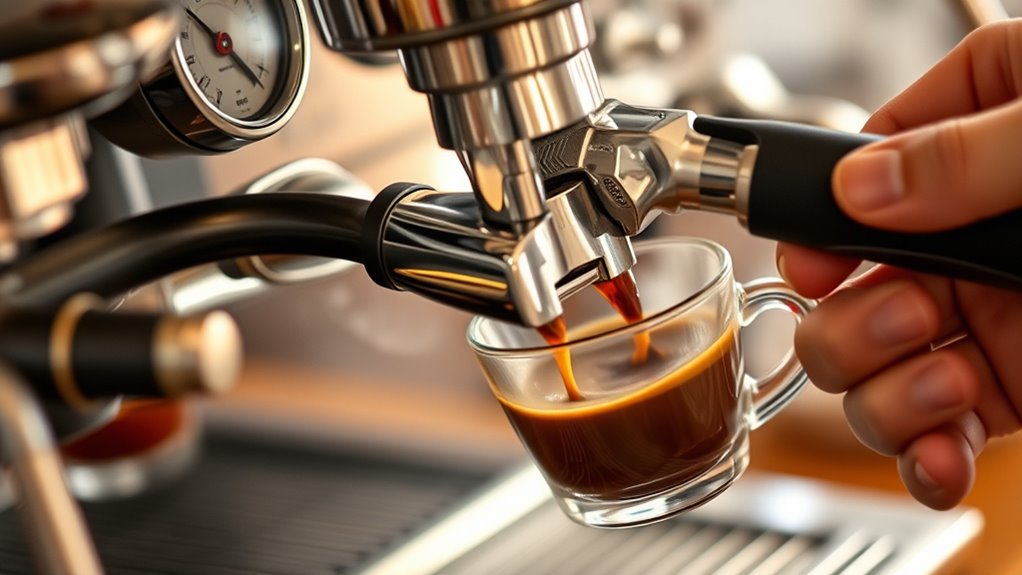
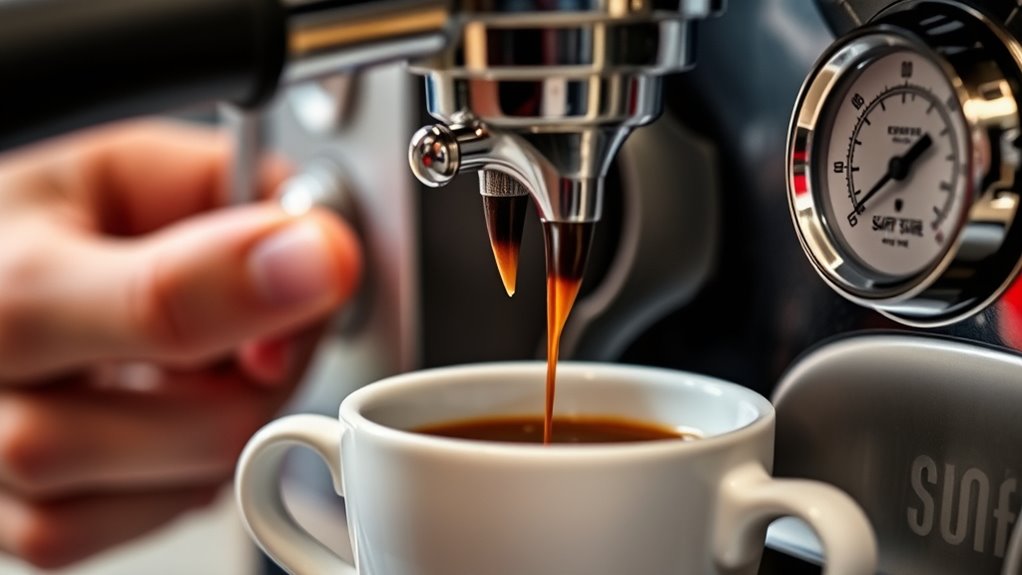
After setting your grind and tamping technique, observe the shot’s flow. Ideally, it should start with a steady, thin stream that turns a rich caramel color as it approaches the two-thirds mark of your target extraction time—usually around 25 to 30 seconds. If it flows too quickly, your grind may be too coarse, or the tamp may be too light; if it’s too slow or drips, the grind might be too fine, or tamping too hard. Adjust accordingly, making small tweaks to your grind adjustment and tamping pressure. Remember, consistency is key. Once you find the right flow, taste the espresso. A well-extracted shot should be balanced—neither sour nor bitter, with a full-bodied, nuanced flavor profile.
In this process, patience and precision are your best tools. By fine-tuning your grind adjustment and perfecting your tamping technique, you control the flow rate and extraction time. This control allows you to access the full potential of your coffee beans, bringing out their best qualities with every shot. Keep experimenting, stay attentive to how each change affects the shot, and over time, dialing in your espresso will become second nature, consistently delivering delicious, quality espresso every time.
Frequently Asked Questions
How Does Ambient Temperature Affect Espresso Extraction?
Ambient temperature affects your espresso extraction by impacting temperature stability, which is vital for consistent results. When it’s too hot or cold, it can cause fluctuations in brew temperature, altering extraction quality. Additionally, ambient humidity influences grind size and tamping consistency, affecting flow rate and extraction. To maintain ideal espresso, control your environment as much as possible, ensuring stable temperature and humidity levels for reliable, high-quality shots.
What’s the Ideal Pressure for Different Coffee Roast Levels?
You should aim for around 9 bars of pressure for most roast levels, but light roasts benefit from slightly higher pressure, around 9.5 bars, to extract more delicate flavors. Dark roasts often need a lower pressure, about 8.5 bars, to avoid over-extraction. Using pressure profiling tailored to the roast level helps you optimize flavor. Studies show that precise pressure control can boost extraction by up to 20%, enhancing your espresso’s complexity.
How Do I Adjust Flow Rate Without Changing Grind Size?
To adjust the flow rate without changing grind size, focus on your tamping technique and brew ratio. You can increase flow by tamping more firmly to create greater resistance, or decrease it by tamping lightly. Additionally, tweaking your brew ratio—using slightly more or less coffee—affects flow. Experiment with these adjustments, ensuring your tamp is consistent and your brew ratio remains ideal for the desired extraction.
Can Machine Age Influence Optimal Brewing Parameters?
Think of your espresso machine as a seasoned musician; over time, its tone can change. Yes, machine age influences ideal brewing parameters because wear and tear from its lifespan affect how it performs. Regular maintenance routines are essential to keep it in harmony. As your machine ages, you might need to adjust pressure, flow, or time to achieve that perfect shot, ensuring consistent flavor despite the years.
How Do I Troubleshoot Uneven Extraction During Dialing In?
To troubleshoot uneven extraction, start by checking your grind consistency and verify it’s uniform for even water flow. Adjust your tamping technique to apply even pressure, avoiding too hard or too soft tamping. Observe the shot closely; if you see channeling or spurts, your grind or tamp might need tweaking. Consistent practice with these adjustments helps you achieve a balanced, even extraction every time.
Conclusion
Now that you’ve explored the nuances of pressure, flow, and time, you’re gently guided toward refining your perfect shot. Remember, every espresso has its own subtle whispers—listening closely helps you bring out its best. With patience and practice, you’ll find that sweet spot where flavors harmonize beautifully. Embrace the journey of dialing in; it’s a delicate dance that rewards your dedication with every satisfying sip. Happy brewing!