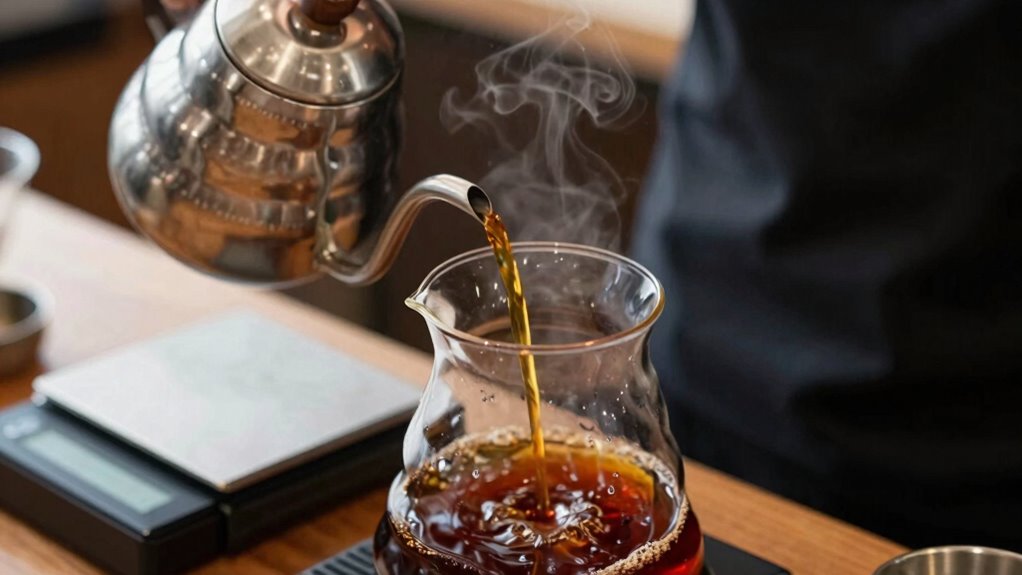

Your brew ratio plays a bigger role in shaping flavor than most beginners realize because it controls how much water interacts with the coffee grounds, affecting how flavors extract. Too much coffee makes the brew overly strong or bitter, while too little creates a weak, flat taste. Adjusting the ratio precisely can highlight delicate notes or enhance richness. If you want to master how these variables work together, keep exploring how changing your brew ratio influences your perfect cup.

Get coffee and tea gear delivered free with Prime
- Fast, free delivery on millions of items
- Prime Video, Amazon Music and more included
- Member-only deals all year
Key Takeaways
- Brew ratios determine the concentration of coffee, directly impacting strength, clarity, and overall flavor balance.
- Small adjustments in brew ratio can significantly alter perceived acidity, bitterness, and body.
- Incorrect ratios may cause over- or under-extraction, leading to flat or sour-tasting coffee.
- Proper brew ratio works in tandem with grind size and temperature to optimize extraction.
- Many beginners overlook ratio importance, but it’s crucial for achieving consistent, personalized flavor profiles.
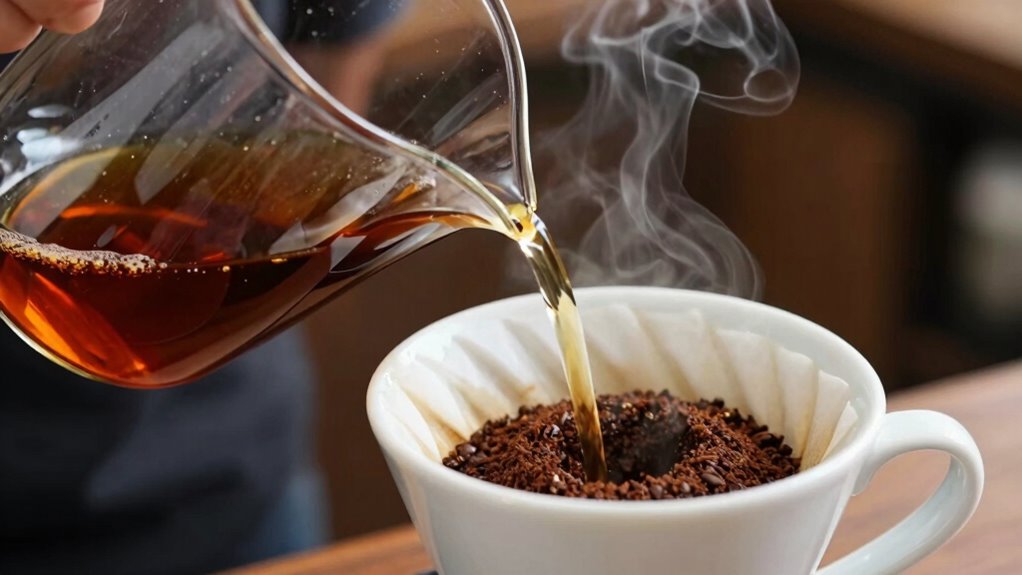
Have you ever wondered how the right brew ratio can transform your coffee’s flavor? It’s more than just a matter of measuring coffee and water; it’s about understanding how each element interacts to create your perfect cup. One key factor often overlooked is the coffee grind. The size of your grind influences how water interacts with the coffee grounds, affecting extraction and flavor. A finer grind increases surface area, leading to a quicker extraction and potentially over-extraction if the brew ratio isn’t adjusted accordingly. Conversely, a coarser grind slows extraction, requiring a different balance of coffee to water. When you’re experimenting with brew ratios, paying attention to your grind size helps ensure consistent, balanced flavor.
Brewing temperature also plays a crucial role. If your water is too hot, it can extract undesirable bitter compounds, overpowering the intended flavors. If it’s too cool, the extraction might be incomplete, leaving your coffee flat or sour. When combined with the right brew ratio, controlling brewing temperature allows you to fine-tune your coffee’s profile. For example, a higher ratio with slightly cooler water can bring out brighter, more delicate notes, while a lower ratio with hotter water can emphasize body and richness. Additionally, understanding the optimal brew ratios for different brewing methods can help you achieve more precise control over flavor extraction.
Furthermore, considering extraction time can help you better understand how these variables work together to produce your desired flavor profile.
Many beginners focus solely on the amount of coffee and water, but the interaction of these variables with grind size and temperature is what truly shapes flavor. A precise brew ratio ensures that the water extracts the optimal flavors without pulling out bitterness or sourness. It’s a delicate balance, and small adjustments can make significant differences. If you’re using too much coffee relative to water, your brew might taste overly intense or thick; too little, and it’ll be weak or underdeveloped. Finding the ideal ratio depends on your chosen grind and brewing temperature, which together influence extraction time and flavor clarity. Recognizing how extraction and flavor are connected helps you develop a more intentional approach to brewing. Additionally, understanding how brewing variables interact can lead to more consistent results. Understanding the interaction of variables allows you to troubleshoot and refine your process more effectively.
Understanding this relationship helps you move beyond guesswork and develop a consistent, enjoyable cup every time. When you experiment with different brew ratios while considering your grind size and temperature, you unlock a new level of control over your coffee’s flavor profile. It’s not just about following recipes but about actively adjusting these variables to match your taste preferences. This knowledge empowers you to craft coffee that’s perfectly tailored to your palate, making each cup an experience that’s uniquely yours.
As an affiliate, we earn on qualifying purchases.
Frequently Asked Questions
How Do Different Brewing Methods Affect Optimal Brew Ratios?
Different brewing methods influence ideal brew ratios through extraction efficiency and flavor balance. For example, espresso needs a lower ratio for intense flavor, while pour-over calls for a higher ratio to highlight clarity. You should adjust ratios based on your method to optimize extraction, ensuring your coffee isn’t under- or over-extracted. Experimenting helps find the perfect balance, revealing how each technique uniquely impacts your coffee’s flavor profile.
Can Adjusting Brew Ratios Improve Coffee Acidity or Sweetness?
Adjusting brew ratios acts like tuning a musical instrument, fine-tuning flavor balance to enhance your coffee’s brightness or sweetness. By increasing water relative to coffee, you can brighten acidity and sharpen taste perception, making the cup feel lively and vibrant. Conversely, a higher coffee ratio can deepen sweetness and mellow acidity. Small tweaks can evoke powerful emotional responses, transforming your coffee experience into a symphony of nuanced flavors.
Are There Standard Brew Ratios for Specialty Coffee Drinks?
Yes, there are standard brew ratios for specialty coffee drinks. Typically, espresso uses a 1:2 ratio, emphasizing strong coffee strength, while drip brews often range from 1:15 to 1:18 for a balanced flavor profile. Adjusting these ratios helps you control coffee strength and flavor balance, allowing you to tailor each drink to your taste. Experimenting within these guidelines can enhance your brewing skills and improve your coffee experience.
How Do Grind Size and Brew Ratio Interact?
You’ll find that grind size and brew ratio interact closely to influence your coffee’s flavor. If your grind isn’t consistent, extraction becomes uneven, affecting taste regardless of ratio. A finer grind increases extraction, but needs a proper brew ratio and temperature to prevent over-extraction. Conversely, a coarser grind requires adjustments in brew ratio and temperature to guarantee balanced flavor. Experimenting with these factors helps you optimize your brew for the best taste.
What’s the Best Way to Experiment With Brew Ratios at Home?
Think of experimenting with brew ratios as tuning a musical instrument—you’re adjusting the strings to reveal richer flavor complexity. Start with small changes, like adding a touch more coffee or water, and note the results. Keep brewing consistently to truly understand how each ratio influences taste. Over time, you’ll discover the perfect balance that highlights the nuances you love, turning your at-home brewing into a symphony of flavor.
Conclusion
Understanding brew ratios is like tuning a guitar—small adjustments can turn a good brew into a great one. Don’t overlook their power; they shape your coffee’s flavor more than most beginners realize. By experimenting with different ratios, you hold the key to revealing your perfect cup. So, embrace the process and remember: the right ratio is your secret ingredient in crafting a truly memorable brew. Your perfect cup is just a ratio away.
Halloween Picks
halloween
As an affiliate, we earn on qualifying purchases.