
At higher altitudes, you’ll notice coffee with denser beans that develop more complex flavors. Cooler temperatures slow growth, allowing the beans to mature fully and produce nuanced sweetness and vibrant brightness. Microclimates at these elevations create unique taste profiles, making each cup more layered and vibrant. The resilience of plants at high elevations also contributes to a richer, more distinctive flavor experience. Keep exploring to discover how altitude continues to influence your favorite coffees.
Key Takeaways
- Higher altitudes lead to slower bean maturation, allowing for the development of complex sugars and nuanced flavors.
- Elevated elevations produce denser beans that support brighter, more vibrant, and layered flavor profiles.
- Microclimates at high altitudes introduce seasonal flavor variability and unique taste notes.
- Resilient coffee plants at high elevations develop resilience, resulting in cleaner acidity and distinctive flavor characteristics.
- Lower altitudes favor faster growth and milder, less complex flavor profiles due to warmer temperatures.
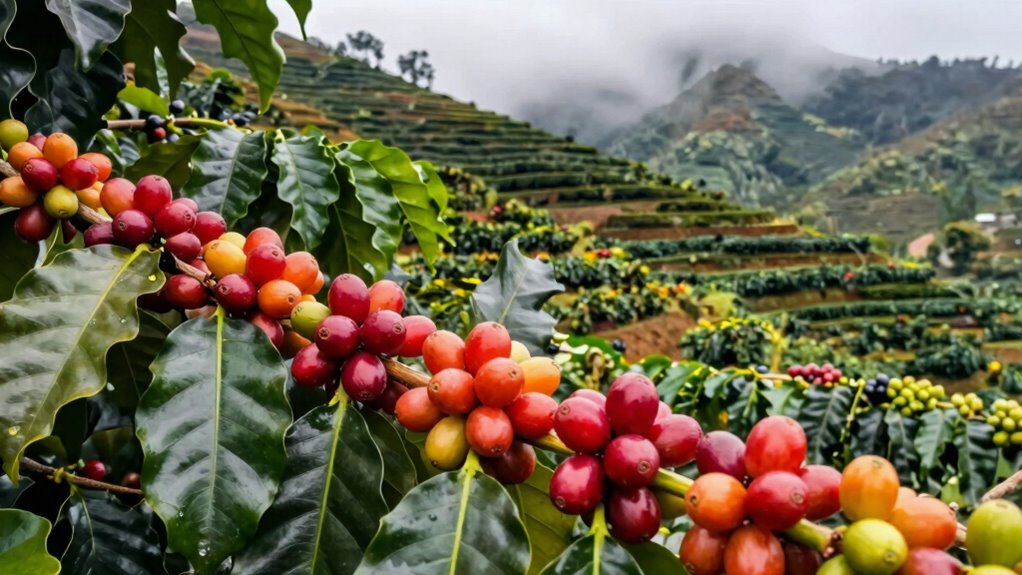
Altitude plays a crucial role in shaping the flavor profile of your coffee, influencing everything from acidity to body. When coffee is grown at higher elevations, the environment challenges the plants in ways that lead to notable differences in the beans. One key factor is how altitude impacts coffee plant resilience. At higher altitudes, coffee plants develop a remarkable ability to adapt to cooler temperatures and thinner air. This resilience means they grow more slowly, which directly affects the beans’ development. Slower maturation allows the beans to develop more complex sugars and flavors, resulting in a richer, more nuanced cup. Additionally, the environmental conditions at higher elevations can lead to greater variability in flavor profiles from season to season, further emphasizing the uniqueness of high-altitude coffees. The microclimate at higher elevations also plays a significant role in influencing the overall flavor profile, as it can vary greatly even within the same region. These microclimates contribute to the diversity of flavor notes present in high-altitude coffees.
Higher elevations foster slower growth, enabling beans to develop richer, more complex flavors for a nuanced coffee experience.
Another critical aspect is the relationship between altitude and bean density. As you go higher, the beans tend to become denser. This increased density is due to the slower growth cycle, which causes the beans to pack more flavor compounds into a compact form. Denser beans often produce a cup with cleaner acidity and more vibrant flavors because they retain their integrity better during roasting. The density also influences how heat transfers during brewing, often leading to a more consistent extraction and a balanced profile. Moreover, the growing environment at high elevations encourages the development of more complex flavor compounds that are unique to these regions. Research shows that higher elevations often result in a more distinctive flavor profile, further setting high-altitude coffees apart. The plant resilience of coffee plants in these areas is a vital adaptation that enhances the quality of the beans.
You’ll notice that at higher elevations, the combination of coffee plant resilience and increased bean density creates a distinctive flavor landscape. The resilience of the plants means they’re better equipped to handle environmental stresses, which pushes the beans to develop heightened complexity. Meanwhile, the denser beans hold onto these complex flavors more effectively, giving you a cup that’s lively, crisp, and layered. These factors work together to elevate the coffee’s brightness and clarity, making high-altitude coffees sought after by connoisseurs.
On the other hand, lower-altitude coffees tend to have a different character. They often grow faster due to warmer temperatures, leading to less dense beans and a milder flavor profile. While these coffees can still be enjoyable, they usually lack the sharpness and depth that altitude imparts. The slower growth at higher elevations also means the plants produce smaller yields, but the quality of each bean compensates for the quantity.
In essence, the altitude where your coffee is grown isn’t just a geographic detail—it’s a fundamental element that shapes the beans’ resilience and density. These qualities combine to craft the unique flavors you experience in each sip. The higher the elevation, the more intricate and vibrant your coffee is likely to be, thanks to the way altitude influences plant resilience and bean density.

Peak Performance High Altitude Organic Coffee – Fair Trade, Low Acid, Non GMO, and Beans Full of Antioxidants – Medium Roast Smooth Tasting USDA Certified Organic Whole Bean Coffee Bag 12 oz
Fair Trade – Low Acid – USDA Certified Organic – Single Origin – High Altitude. If We Could…
As an affiliate, we earn on qualifying purchases.
As an affiliate, we earn on qualifying purchases.
Frequently Asked Questions
How Does Altitude Influence Coffee Bean Development Stages?
Altitude influences coffee bean development stages by affecting soil composition and microclimate effects. At higher elevations, cooler temperatures slow down cherry maturation, allowing beans to develop complex flavors. You’ll notice that soil rich in minerals combined with microclimate effects like increased airflow and sunlight exposure enhances bean density and acidity. This interplay results in beans that are more vibrant and nuanced, giving your coffee a distinctive, high-altitude character.
Are Certain Coffee Varieties More Affected by Altitude?
You’ll find that certain coffee varietals, like Bourbon and SL28, are more affected by altitude effects. Statistics show that high-altitude regions can enhance acidity and complex flavors in these beans more markedly than others. Altitude effects influence how these varietals develop, often resulting in brighter, more nuanced profiles. So, if you love a vibrant cup, choosing high-altitude-grown coffee varietals can truly elevate your experience.
What Are the Best Altitude Ranges for Specific Coffee Flavors?
You should aim for altitude ranges around 1,200 to 2,000 meters for ideal flavor profile variation. At these heights, altitude enhances acidity, giving your coffee a bright, lively taste. Lower altitudes tend to produce milder, less acidic coffee, while higher elevations can develop more complex, nuanced flavors. Matching altitude to your preferred flavor profile helps you achieve the desired balance of brightness and depth in your coffee.
Does Altitude Impact Coffee Bean Harvest Timing?
Yes, altitude impacts coffee bean maturation and harvest timing. Higher altitudes slow down the maturation process, often resulting in a later harvest. This slower development enhances acidity, which is a hallmark of high-altitude coffees. You’ll notice that beans grown at greater elevations tend to mature more gradually, giving you a richer, more complex flavor profile. So, when considering harvest timing, altitude plays a vital role in shaping both the process and the final coffee quality.
Can Altitude-Related Flavor Changes Be Replicated at Lower Elevations?
You can’t fully replicate altitude-related flavor changes at lower elevations because soil composition and microclimate variations greatly influence the coffee’s profile. Higher elevations often have unique soil nutrients and cooler temperatures, which develop complex flavors. While you can mimic some effects by adjusting shade, watering, or soil treatments, the distinct microclimate and soil composition of high-altitude regions create nuances that are challenging to reproduce exactly at lower elevations.
Peak Performance High Altitude Organic Coffee – Fair Trade, Low Acid, Non GMO, and Beans Full of Antioxidants – Medium Roast Smooth Tasting USDA Certified Organic Whole Bean Coffee Bag 12 oz
Fair Trade – Low Acid – USDA Certified Organic – Single Origin – High Altitude. If We Could…
As an affiliate, we earn on qualifying purchases.
As an affiliate, we earn on qualifying purchases.
Conclusion
Understanding how altitude influences coffee flavor helps you appreciate each sip even more. As you explore beans from different elevations, you’ll notice the unique notes and complexities that altitude brings out. It’s clear as day that elevation plays a major role in shaping coffee’s character. So, next time you brew a cup, remember that the secret lies high up in the mountains—truly, the proof is in the pudding. Enjoy every flavorful journey!

Coffee Moisture Tester for Moisture Content, Density, Sample Temperature, Patented Bean Distributor, HD Touchscreen, Portable, Real-Time Accuracy, for Professional Roasters & Coffee Enthusiasts
3-in-1: Designed for coffee professionals, the CoffMeter M1 coffee moisture meter integrates moisture content, density, and sample temperature…
As an affiliate, we earn on qualifying purchases.
As an affiliate, we earn on qualifying purchases.

Modulating the Flavor Profile of Coffee
As an affiliate, we earn on qualifying purchases.
As an affiliate, we earn on qualifying purchases.