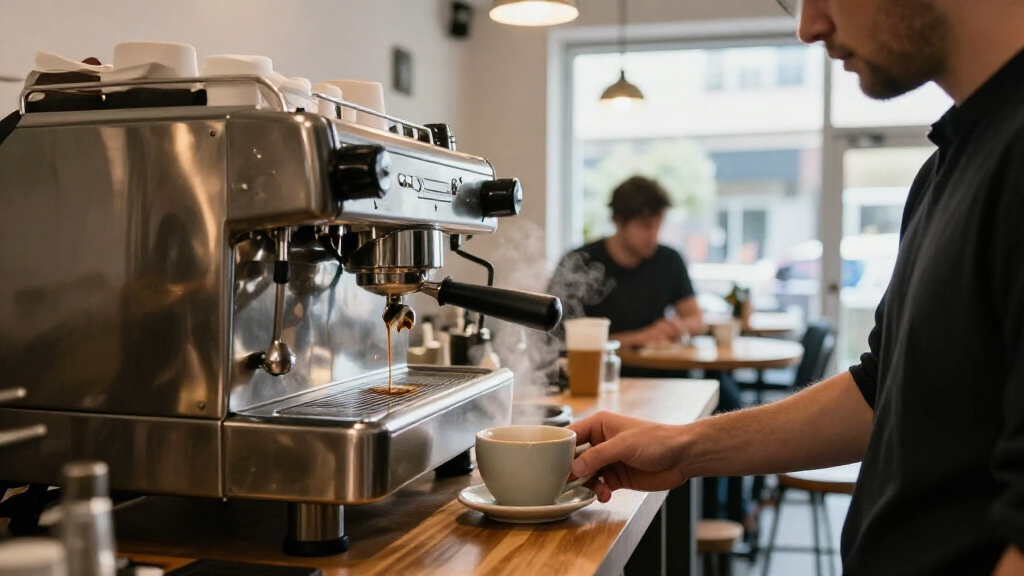
For most cafés that need a practical balance of throughput, familiar controls, and room to grow, I name the Nuova Simonelli Appia Life 2-Group Volumetric my best overall commercial espresso machine. The Appia Compact 2-Group suits businesses that need two group heads in less space, while the Appia II 1-Group is a simpler fit for lower-volume service. The key tradeoff is not simply group count: capacity, counter space, electrical requirements, and how much control the barista wants all shape the right choice. The Sciolix adds a touchscreen and PID controls, while the Rocket Appartamento TCA is a smaller semi-automatic machine whose fit for sustained commercial service needs careful scrutiny. Read on for the full comparison, buying criteria, and recommendations by business type.

Get coffee and tea gear delivered free with Prime
- Fast, free delivery on millions of items
- Prime Video, Amazon Music and more included
- Member-only deals all year
Complete the kit


Key Takeaways
- The Appia Life 2-Group Volumetric ranks first for businesses that need a commercial two-group workflow with programmed volume control; buyers should still confirm installation and service requirements for their site.
- The Appia Compact 2-Group prioritizes footprint over extra capacity. It keeps two group heads in the lineup, but a compact chassis does not remove the need to check counter clearance, power, and plumbing.
- The Appia II 1-Group is the lower-throughput choice, not a scaled-down two-group substitute. It suits modest service better than a café expecting simultaneous drink orders.
- The Sciolix differentiates itself through PID control and a touchscreen. Those interfaces may appeal to operators who value visible settings, but they do not by themselves prove long-term serviceability or sustained commercial readiness.
- The Rocket Appartamento TCA is the outlier in a commercial-focused list. Its semi-automatic format and smaller footprint may suit limited-volume use, while buyers planning busy service should prioritize the commercial-duty Appia models.


| commercial espresso machine | Group heads | Power and voltage | Dimensions |
|---|---|---|---|
| Sciolix 2-Group Commercial Esp | 2 | 4600 W; 110 V | 20.6 × 32.2 × 27.5 in (D × W × H) |
| Rocket Espresso Appartamento T | — | 1350 W; 120 V | 17.6 × 10.7 × 14 in (D × W × H) |
| Nuova Simonelli Appia II Semi- | — | — | — |
| Nuova Simonelli Appia Compact | 2 | — | — |
| Nuova Simonelli Appia Life 2-G | 2 | 3400 W; 240 V | — |
| Nuova Simonelli Appia Life II | 2 | — | 21 x 22 x 22 in (D x W x H) |
More Details on Our Top Picks
Sciolix 2-Group Commercial Espresso Machine with PID Control and Touchscreen
The Sciolix is the most adjustment-focused choice here: independent PID settings for its two coffee boilers, programmable extraction and pre-infusion, and a separate 8-liter steam boiler give a café more control over brewing and milk service than the simpler Appia II. Its touchscreen, scheduled startup, and automatic cleaning also help standardize opening and routine upkeep. A rotary pump and pressure gauges support monitoring, while the stated daily capacity of about 150–250 cups points toward sustained service rather than occasional use.
The tradeoff is installation. At 154.3 pounds and more than 32 inches wide, it needs a substantial counter and careful placement; its 110 V requirement may also be a mismatch for some commercial electrical setups. I’d choose it over the compact Appia Compact when control and separate boiler capacity matter more than saving counter space.
Pros:- Independent PID control and programmable pre-infusion allow operators to tailor extraction.
- Separate coffee and steam boilers support brewing and milk service with dedicated capacity.
- Automatic scheduling and cleaning can reduce routine opening and maintenance tasks.
- Rotary pump, pressure gauges, and stainless steel components support operational monitoring.
Cons:- Its 32.2-inch width and 154.3-pound weight demand substantial counter space and installation planning.
- The 110 V specification may not match the electrical supply in some commercial locations.
- Touchscreen and programmable functions may add complexity for teams seeking simpler controls.
Best for: Cafés and restaurants that want programmable brewing, separate coffee and steam boilers, and automated cleaning for regular service.
Not ideal for: Small carts or kitchens with limited counter space, or businesses whose electrical setup is not compatible with its 110 V requirement.
- Group heads:2
- Coffee boilers:Two 1-liter boilers
- Steam boiler:8 liters
- Pump:Rotary
- Power and voltage:4600 W; 110 V
- Daily capacity:Approximately 150–250 cups
- Dimensions:20.6 × 32.2 × 27.5 in (D × W × H)
- Weight:154.3 lb
Our verdict“Choose the Sciolix when programmable control and separate boiler capacity matter more than a compact footprint or straightforward operation.”
Rocket Espresso Appartamento TCA Semi-Automatic Espresso Machine, Black/Copper
The Appartamento TCA is the clear outlier in this commercial-focused lineup: it is a compact, 120 V home machine, not a café workhorse. Its 10.7-inch width, 2.5-liter reservoir, and heat exchanger let a home user brew and steam without installing a plumbed commercial system. Four selectable brew temperatures and an E61 group head offer more adjustment than the button-controlled Nuova Simonelli Appia II, while the included portafilters, baskets, and tamper make it a fuller starting setup.
That flexibility comes with limits. The 1.8-liter boiler and 1350 W rating are not a substitute for the capacity of the two-group machines, and semi-automatic operation leaves shot timing to the user. Compared with the Appia Compact, this Rocket saves width and installation demands but gives up the commercial workflow features a café needs.
Pros:- At 10.7 inches wide, it fits narrower home counters than the commercial two-group machines.
- Heat exchanger design allows brewing and steaming at the same time.
- Four brew-temperature settings provide adjustment beyond a basic home machine.
- Includes two portafilters, three baskets, a tamper, and a group brush.
Cons:- Its single-group, 1.8-liter heat exchanger setup is a poor fit for sustained café volume.
- Semi-automatic operation requires the user to manage shot timing.
- At 48.5 pounds, it is heavy to move despite its compact width.
Best for: Home espresso enthusiasts who want a narrow machine with manual brewing, selectable temperatures, and simultaneous steaming.
Not ideal for: Cafés or restaurants serving repeated drinks through a rush; its home-oriented reservoir and single group are not built for that workflow.
- Operation:Semi-automatic
- Boiler type and capacity:Heat exchanger; 1.8 L
- Water reservoir:2.5 L
- Group head:E61
- Brew temperature settings:4
- Power and voltage:1350 W; 120 V
- Dimensions:17.6 × 10.7 × 14 in (D × W × H)
- Warranty:3 years
Our verdict“Pick the Appartamento TCA for a space-conscious home setup, not as a replacement for a two-group commercial machine.”
Nuova Simonelli Appia II Semi-Automatic 1-Group Espresso Machine
The Appia II suits a business that needs a commercial-ready, one-group machine rather than the throughput and footprint of a two-group setup. Its 5-liter capacity and compatibility with an external pump make it a more business-oriented option than the home-focused Rocket Appartamento TCA. Button controls keep the basic workflow direct, while the semi-automatic format gives staff hands-on control over each shot. For a small café, service station, or venue with modest espresso demand, that narrower role can be a sensible alternative to the larger Sciolix.
The tradeoff is that the supplied details leave key installation questions unanswered: the pump is described as external, and no group-head count beyond the one-group listing or dimensions are provided. At 130 pounds, it is still a substantial piece of equipment, and staff must operate each shot manually. I’d skip it if a busy bar needs two simultaneous group positions or built-in volumetric dosing.
Pros:- One-group format offers a smaller service scale than the two-group Sciolix and Appia Compact.
- 5-liter capacity is specified for a commercial-oriented machine.
- External-pump compatibility offers flexibility in pump configuration.
- Button controls and a reusable filter support a straightforward, repeatable basic workflow.
Cons:- Semi-automatic operation requires staff to manage each shot.
- The 130-pound weight makes placement and movement difficult.
- An external pump setup may require additional planning and equipment.
Best for: Small cafés, restaurants, or service stations with modest espresso demand that want a commercial-ready one-group machine.
Not ideal for: High-volume cafés needing two group heads, programmed dosing, or a clearly specified self-contained pump setup.
- Model:Appia II
- Operation:Semi-automatic
- Capacity:5 liters
- Pump compatibility:External pump
- Power:800 W
- Weight:130 lb
- Coffee input:Ground coffee
- Material:Copper
Our verdict“Choose the Appia II for modest commercial demand where one group and manual shot control are sufficient.”
Nuova Simonelli Appia Compact Semi-Automatic 2-Group Espresso Machine, 220 V
The Appia Compact is the space-conscious café pick: its 55 cm width brings two groups to counters where a wider machine may not fit. Two steam wands and a hot water wand support parallel milk preparation and other drink tasks, while the 7.5-liter boiler gives it a more clearly specified commercial setup than the one-group Appia II. Soft Infusion System and raised group heads add workflow-focused features without the Sciolix’s touchscreen and programmable pre-infusion controls.
Its compact name does not make it a home appliance. The machine is aimed at restaurants, small coffee shops, and carts, and its 220 V requirement calls for a compatible electrical supply. The supplied information also describes the operating mode as both semi-automatic and fully automatic, so buyers should confirm the exact configuration before ordering. Compared with the wider Appia Life two-group model, this one prioritizes counter width over listed volumetric dosing features.
Pros:- 55 cm width suits tighter commercial counters than many two-group setups.
- Two steam wands and a hot water wand support varied service tasks.
- 7.5-liter boiler provides specified capacity for commercial use.
- Soft Infusion System and raised group heads support practical bar workflows.
Cons:- Requires a compatible 220 V electrical supply.
- The listed operating mode is inconsistent, so buyers should verify the exact configuration.
- Its commercial features and installation needs make it excessive for most home users.
Best for: Small cafés, restaurant bars, and carts that need two groups and dual steam wands within a 55 cm counter width.
Not ideal for: Locations without 220 V power or buyers who need a clearly specified dosing workflow before selecting a machine.
- Group heads:2
- Width:55 cm
- Boiler capacity:7.5 L
- Water capacity:1.97 gallons
- Voltage:220 V
- Steam wands:2
- Coffee input:Ground coffee
- Material:Copper
Our verdict“Choose the Appia Compact when two-group service is needed but counter width is the main constraint.”
Nuova Simonelli Appia Life 2-Group Volumetric Espresso Machine
The Appia Life makes the strongest case for a repeatable two-group café workflow. Programmable volumetric dosing offers four shot volumes per group, so staff can use button-based portions instead of relying only on manual timing. That gives it a clearer service-efficiency advantage over the semi-automatic Appia II, while automated backflushing reduces one routine cleaning task. Cool-touch steam, push-pull controls, raised groups, and cup risers address the practical demands of a busy bar rather than adding extra recipe programming like the Sciolix.
Its installation requirements are the main dividing line: it needs 240 V power, a cold-water connection, a drain, and a water softener to maintain the warranty. This is not a plug-in option for a modest shop or mobile cart. I’d favor it over the Appia Compact when programmable shot volumes and automated backflushing take priority, but buyers should plan the plumbing and water treatment first.
Pros:- Four programmable shot volumes per group support consistent portions across staff.
- Automated backflushing reduces a recurring group-cleaning task.
- Cool-touch steam wand and push-pull controls suit frequent milk service.
- Raised groups, cup risers, and a reverse mirror support different cup sizes and visibility.
Cons:- Requires a 240 V electrical supply, cold-water connection, and drain.
- A water softener is required to maintain the warranty.
- Installation requirements make it a poor fit for carts and lightly equipped venues.
Best for: Established cafés that want programmed shot portions for multiple staff and have the required 240 V supply, plumbing, drain, and water treatment.
Not ideal for: Mobile carts, small shops without plumbed water and drainage, or locations unable to provide 240 V power and a water softener.
- Group heads:2
- Dosing:Programmable volumetric; 4 shot volumes per group
- Power and voltage:3400 W; 240 V
- Water supply:Cold-water connection and drain required
- Water treatment:Water softener required to maintain warranty
- Steam wand:Cool-touch with push-pull controls
- Cleaning:Automated backflushing
- Warranty:2 years
Our verdict“Choose the Appia Life when a plumbed café needs two groups and programmable dosing for repeatable service.”
Nuova Simonelli Appia Life II Compact 2-Group Volumetric Espresso Machine, Black
I’d choose the Appia Life II Compact for a café that needs two-group service and repeatable shot volumes but has limited counter space. Its programmable volumetric dosing helps staff serve consistent shots without relying on manual timing, while the Soft Infusion System supports extraction when coffee preparation varies. Compared with the Nuova Simonelli Appia Life 2-Group Volumetric Espresso Machine, this model’s compact format is the clearer fit for a tighter workspace; the tradeoff is a smaller 7.5-liter boiler, which may be less suited to sustained, heavy-volume service. Cool-touch steam wands and raised group heads add practical workflow and visibility benefits. Still, “compact” is relative: this is a commercial two-group machine, and buyers need suitable counter space and a compatible 110 V or 220 V connection.
Pros:- Compact format uses less counter space than many two-group setups.
- Programmable volumetric dosing supports consistent shot volumes across staff shifts.
- Cool-touch steam wands help reduce burn risk during milk steaming.
- Raised group heads provide more workspace visibility.
Cons:- The 7.5-liter boiler may be limiting during sustained high-volume service.
- Requires a suitable 110 V or 220 V power connection.
- Despite its compact design, a two-group machine still needs substantial counter space.
Best for: Small cafés and food-service counters that need two-group capacity, programmable dosing, and a more space-conscious commercial setup.
Not ideal for: High-volume venues that need a larger boiler for sustained demand, or home users and small counters without room and power for a commercial two-group machine.
- Brand:Nuova Simonelli
- Model:Appia Life II
- Type:Volumetric espresso machine
- Group heads:2
- Boiler capacity:7.5 L
- Voltage:110 / 220 V
- Power:1500 / 3000 W
- Dimensions:21 x 22 x 22 in (D x W x H)
- Certification:NSF approved
Our verdict“Choose this model when a space-conscious café needs two groups and repeatable volumetric shots, but skip it for sustained high-volume service or a cramped setup.”
How We Picked
I ranked these machines around the demands of commercial service rather than feature count alone. The main criteria were group capacity, control style, likely workflow fit, footprint, electrical configuration where specified, and the information available about the machine’s intended use. A two-group machine can support more simultaneous work than a one-group model, but only if a business has the counter space, utilities, staffing, and order volume to make use of it.
The Appia Life 2-Group Volumetric leads because its combination of two groups and volumetric dosing aligns closely with repeatable café workflows. The Appia Compact follows for buyers who need two groups with a tighter footprint, while the Appia II 1-Group makes more sense at lower volume. I place the Sciolix and Rocket lower because their stated controls or compact format do not, on their own, establish the same clear commercial workflow fit; the Appia Life II Compact remains a focused space-saving alternative, with its black finish adding appearance rather than proven operating advantage.
Factors to Consider When Choosing Commercial Espresso Machines
Choosing among commercial espresso machines starts with the work the machine must handle each day, not the most eye-catching control panel. I recommend mapping expected drink volume, staffing, utilities, and service access before comparing features. These broader checks can prevent an expensive mismatch even when a model looks right on paper.
Match Group Count to Peak-Hour Demand
Estimate how many espresso drinks you expect during your busiest 15-minute period, not just across a full day. A two-group machine gives a team more scope to prepare drinks concurrently, but it cannot compensate for slow order flow, too few staff, or limited grinder capacity. A one-group machine may be sensible for a small restaurant or low-volume counter if espresso is not the main business. A common mistake is buying extra groups for a hoped-for future volume while accepting the higher space and installation demands now. I would favor a machine that fits realistic peak demand and leave room in the workflow for milk steaming, rinsing, and handoff.
Check Utilities Before Choosing a Model
Commercial machines can require specific voltage, amperage, water supply, drainage, and ventilation arrangements. The Appia Compact listing specifies 220 V, a detail that makes an electrical check especially relevant; other models also need their exact specifications confirmed with the seller or manufacturer. Do not assume a plug can be changed or that an existing café circuit can support a new machine. Ask an electrician and installer to verify the site requirements before ordering, including whether water treatment is needed for local conditions. Treating installation as an afterthought can delay opening or add work that a product comparison cannot reveal.
Choose Controls Around Staff Workflow
Volumetric dosing can help staff repeat shot volumes with less manual timing, which is useful when several people share a station or service gets busy. Semi-automatic controls give the barista more direct control over shot stopping, which some experienced operators prefer but can demand consistent training. PID temperature control and touchscreen interfaces, like those listed on the Sciolix, may make settings more visible; they do not automatically make drinks better or daily operation easier. Before paying for a particular interface, ask who will use it, what settings they need to change, and how the machine behaves when staff turnover occurs. Clear training and a repeatable recipe often matter more than a longer feature list.
Treat Footprint as a Workflow Measurement
A compact machine can free counter space, but the listed width is only part of the installation footprint. Allow for cup storage, grinder placement, knock box access, milk pitchers, cleaning, and room for a technician to reach service points. Two group heads in a compact chassis may suit a narrow bar, yet crowded accessories can still slow a team. Measure the full station and mark the machine’s operating and maintenance clearances before committing. This is particularly useful when comparing the Appia Compact models with larger two-group options: the smaller chassis helps only if the rest of the station remains workable.
Plan for Service, Water Quality, and Downtime
In a business, maintenance affects whether drinks can be served, not just how much time cleaning takes. Ask about local technician coverage, parts availability, warranty terms, scheduled maintenance, and what the machine requires for backflushing and water treatment. A machine with attractive controls may be a poor fit if repairs require long waits or specialized parts unavailable nearby. Hard or untreated water can also shorten equipment life and change maintenance needs, so get local water tested and follow the manufacturer’s treatment guidance. I would weigh a dependable service plan more heavily than cosmetic upgrades when the machine is central to daily sales.
Pay for Capacity and Support, Not Just Appearance
A premium finish or advanced interface is worthwhile only when it supports the business’s operating needs. Spend more when added group capacity, repeatable dosing, stronger service support, or a better fit for peak demand has a clear payoff. Spend less when service volume is modest and a simpler one-group workflow will handle orders without creating a bottleneck. Avoid choosing a machine solely because it looks commercial: the Rocket Appartamento TCA, for example, should be matched carefully to expected workload rather than assumed to equal a dedicated café machine. Compare total setup needs, training, water treatment, and service arrangements alongside the machine itself.
Frequently Asked Questions
Is the Rocket Appartamento TCA suitable for a busy café?
I would not choose it for sustained, high-volume café service without confirming its commercial-duty suitability with the manufacturer and a qualified service provider. It is the lineup’s outlier: the other options are Appia models or a two-group machine explicitly presented with commercial features. A smaller footprint can help in a limited space, but it does not establish the throughput or service support a busy bar needs. For regular rushes, I would compare the Appia two-group choices first and confirm utilities, warranty coverage, and local parts support.
Should I choose a one-group machine or a compact two-group machine?
Choose based on simultaneous orders and staffing, rather than on the word compact. A one-group machine can be a sensible fit when espresso demand is limited and the menu has other drinks or service tasks. A compact two-group model is more suited to a team that needs to prepare espresso drinks concurrently but has restricted counter space. It still requires enough room for grinders, milk preparation, and safe access, plus compatible electrical service. If peak demand is uncertain, track expected orders and ask an installer to assess the station before buying.
Does volumetric dosing matter if my baristas are experienced?
It can still help experienced teams keep shot volumes more consistent across shifts, especially when more than one barista works the machine. Semi-automatic operation may suit a skilled barista who wants direct control over stopping each shot, so volumetric dosing is not automatically the better choice for every café. Consider how recipes are set, how staff are trained, and whether consistency or hands-on control is the larger priority. Also confirm how easily dosing settings can be adjusted for different coffees and recipes. The Appia Life volumetric models are the clearest fit here for businesses that favor repeatable programmed portions.
What should I confirm before ordering a 220 V commercial espresso machine?
Have a qualified electrician verify the outlet, circuit capacity, voltage, and any required wiring before purchase. The Appia Compact listing specifies 220 V, but buyers should confirm the exact machine configuration and site requirements rather than relying on a general product name. Ask the seller or manufacturer for power details, water and drainage needs, and installation clearances. Also check whether the machine can be delivered and installed at the intended location. A pre-purchase site check can prevent delays and unexpected electrical work.
Is the Sciolix touchscreen and PID control a reason to choose it over an Appia model?
Those features may be appealing if staff need visible settings and temperature control, but they are only part of a commercial purchase decision. Compare the machine’s stated capacity and controls with the Appia models, then ask about commercial-use guidance, warranty coverage, parts, and local service. A touchscreen does not establish that maintenance is simple or that repairs will be readily available. If your business depends on daily uptime, service access and installation compatibility may outweigh interface features. I would seek written answers to those questions before choosing the Sciolix over a more clearly café-oriented option.
Conclusion
For a café seeking the strongest all-around fit in this group, I recommend the Nuova Simonelli Appia Life 2-Group Volumetric, subject to confirming site and service requirements. The Appia Compact 2-Group is my pick for buyers who need two-group capacity in a tighter station, while the Appia II 1-Group is the more sensible choice for lower-volume businesses and operators who want a simpler semi-automatic workflow. I would treat the Sciolix as the feature-led alternative for buyers drawn to PID control and touchscreen settings, but only after verifying support and commercial suitability. The Rocket Appartamento TCA is best reserved for limited-volume needs rather than assumed to be a busy-café workhorse. For a premium recommendation, I would favor the Appia Life 2-Group for its commercial workflow features; for value, choose the least-capable model that can still meet your real peak demand, since no verified pricing or ownership-cost data is available here.