Coffee density affects how you should grind and brew for the best flavor. Denser beans, like lighter roasts, often need a finer grind to extract full flavors, while less dense, darker roasts do better with a coarser grind to avoid over-extraction. Grinding consistency and brew adjustments depend on knowing the bean’s density, which helps prevent common issues like over- or under-extraction. Keep exploring to discover how understanding density can elevate your coffee game even further.
Key Takeaways
- Coffee density affects grind size; denser beans need a finer grind for optimal extraction.
- Roasting level influences density, impacting how beans respond during grinding and brewing.
- Moisture content contributes to density variations, affecting grind consistency and extraction quality.
- Properly adjusting grind size based on density prevents over- or under-extraction in brewing.
- Understanding density helps troubleshoot brewing issues and achieve consistent, flavorful results.
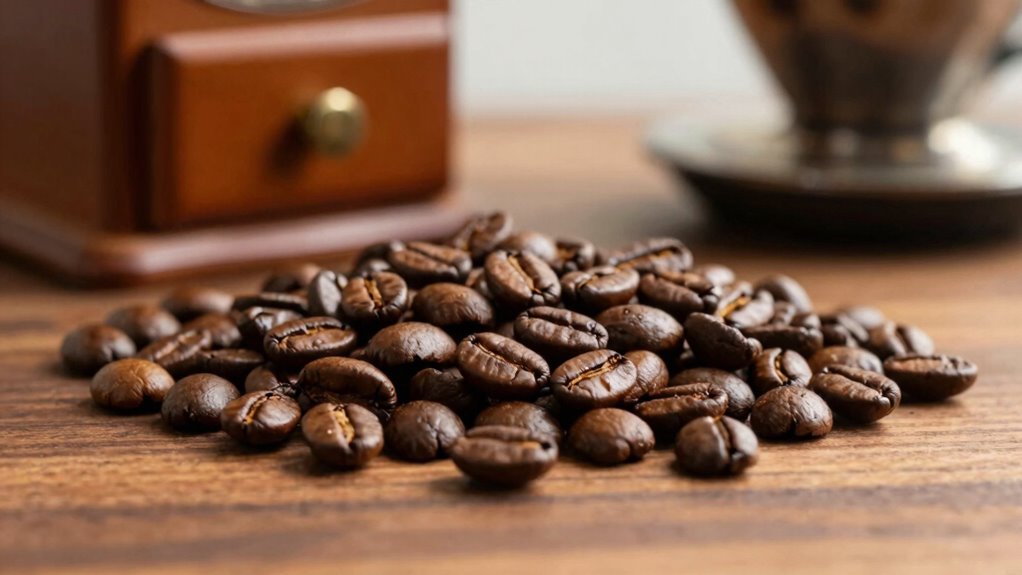
Understanding coffee density is essential because it directly influences how your brew turns out. When you grasp the concept of coffee density, you gain insight into how different beans and roasting levels impact your grind and, ultimately, your cup. Coffee roasting plays a key role here; darker roasts tend to be less dense because the prolonged heat causes the beans to expand and lose moisture. Lighter roasts, on the other hand, are denser and retain more of their original weight. Recognizing this difference helps you adjust your grind size accordingly to guarantee proper extraction. If you don’t account for density variations, you might end up with over-extracted bitter coffee or under-extracted sourness, depending on your grind. Additionally, bean moisture content can affect the overall density and should be considered when selecting your beans for specific brewing methods. This is why understanding the density differences between various coffee beans is crucial for consistent brewing.
Understanding coffee density helps you adjust grind size for perfect extraction and flavor.
Grind consistency is another essential factor influenced by coffee density. When your coffee beans are of uniform density, you can achieve a more consistent grind, which leads to better extraction. Inconsistent density results in uneven particle sizes, making it difficult to control brewing variables. For example, if some beans are denser, they resist grinding and produce larger particles, whereas less dense beans grind into finer particles. This inconsistency can cause your brew to be uneven, with some areas over-extracted and others under-extracted. The key to good coffee starts with understanding how density affects grind size and guaranteeing you use a quality grinder that produces uniform particles. This way, you maximize flavor extraction and get a balanced, flavorful cup every time. Additionally, density variation can occur even within the same batch of beans, emphasizing the importance of understanding these subtle differences for precision brewing.
Knowing the relationship between coffee density and grind consistency also helps when you’re experimenting with different brewing methods. For pour-over or espresso, where precision matters, adjusting your grind based on the bean’s density guarantees optimal extraction. For instance, if you’re using a lighter roast, you might need a slightly finer grind because the denser beans require more contact with water to release their flavors fully. Conversely, for darker roasts, a coarser grind might be better to prevent over-extraction. Paying attention to these subtle differences improves your brewing skills and results in a more enjoyable coffee experience.
In essence, understanding coffee density isn’t just a technical detail; it’s a practical tool that influences your entire brewing process. By considering how roasting affects density and how that impacts grind consistency, you can make smarter adjustments. This knowledge empowers you to tailor your grind size and brewing technique to match the specific beans you’re working with, leading to a richer, more satisfying cup. Additionally, recognizing density variations can help you troubleshoot brewing issues and refine your technique for consistently better results.
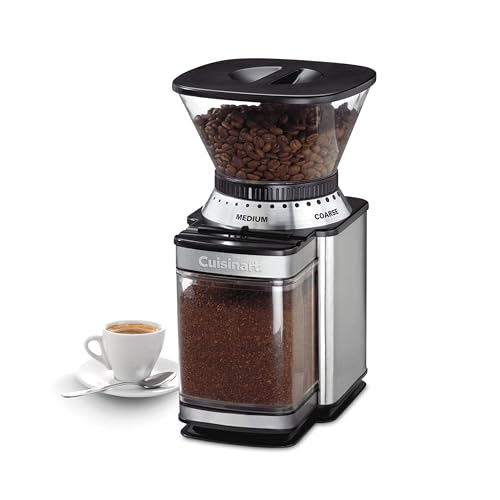
Cuisinart Coffee Grinder, Electric One-Touch Automatic Burr Coffee Grinder with 18-Position Grind Selector, Cup Size Selector for 4 – 18 Cups, DBM-8P1, Black Stainless
ENJOY OPTIMUM FLAVOR: The Cuisinart Coffee Grinder with 18-position slide-dial grind selector provides a uniform grind from ultra-fine…
As an affiliate, we earn on qualifying purchases.
As an affiliate, we earn on qualifying purchases.
Frequently Asked Questions
How Does Coffee Density Affect Storage Longevity?
Coffee density impacts storage longevity because denser beans typically contain more moisture, which can lead to quicker spoilage if not stored properly. You should focus on ideal storage conditions—cool, dark, and airtight environments—and use quality packaging materials that prevent air and moisture from seeping in. Proper storage helps preserve the beans’ freshness, flavor, and aroma, regardless of their density, ensuring your coffee stays good longer.
Can Density Influence the Flavor Profile Beyond Grinding and Brewing?
Think of coffee density as the soul of your beans—it influences more than just grind size. Yes, it can shape your flavor profile beyond grinding and brewing. Higher density beans often hold onto their aroma better and allow for richer flavor extraction, resulting in a more complex, vibrant cup. Conversely, lower-density beans might lose aroma faster, leading to a flatter taste. So, density truly impacts your coffee’s overall character.
Does Coffee Density Vary With Different Coffee Bean Origins?
Yes, coffee density varies with different bean origins. You’ll notice that beans from regions like Ethiopia or Yemen often have higher density, making them more compact, while those from Central America tend to be lighter. Density variation influences how you grind and brew your coffee. By understanding the bean origin, you can adjust your technique to optimize flavor extraction, ensuring a better taste experience tailored to each unique bean.
Is There a Standard Method to Measure Coffee Density Accurately?
You’ll be interested to know that a standard method for measuring coffee density involves using a volumetric or gravimetric approach, ensuring consistency across batches. While there’s no universal standard, accuracy standards are often set by industry organizations, emphasizing precise density measurement. This helps you optimize grind size and brewing methods, ensuring you get the best flavor extraction. Accurate density measurement can improve your coffee experience markedly.
How Does Roasting Level Impact Coffee Density?
Roasting impact profoundly alters coffee density, as darker roasts tend to be less dense due to expansion and loss of moisture. Lighter roasts are denser because they retain more moisture and haven’t expanded as much. When considering density measurement, keep in mind that roasting levels influence the results, making it essential to adjust your measurements accordingly. This understanding helps you optimize grinding and brewing for the best flavor.

SHARDOR Conical Burr Espresso Coffee Grinder Electric with Precision Timer 2.0, Touchscreen Adjustable Burr Mill with 51 Precise Settings for Home Use, Anti-static, Stainless Steel
Premium 40 Millimeter Stainless Steel Conical Burr: Designed to minimize grinding heat and protect the essential oils in…
As an affiliate, we earn on qualifying purchases.
As an affiliate, we earn on qualifying purchases.
Conclusion
Understanding coffee density helps you fine-tune your grind size and brewing method, ensuring each cup hits just right. When you pay attention to how dense your beans are, you reveal better extraction and richer flavors. It’s no coincidence that small adjustments can transform your brewing experience, making every sip more satisfying. So, embrace the quirks of your beans, and let their density guide you to a perfect brew—because sometimes, the tiniest detail makes all the difference.

Maestri House Mini Coffee Scale with Timer, USB-C Rechargeable Espresso Scale, 2kg/0.1g Accurate Scale for Espresso and Pour-Over Coffee, Portable Digital Kitchen Scale with Auto Timer (Black&Silver)
【Ultra Small, Yet Professional】The Espresso Scale is small enough to fit in your palm. It measures 4.13*4.13*0.78 inches…
As an affiliate, we earn on qualifying purchases.
As an affiliate, we earn on qualifying purchases.

Agratronix Coffee Moisture Tester Model 08150
MOISTURE TESTER: Specially calibrated to provide accurate moisture results for a variety of coffee commodities, the AgraTronix coffee…
As an affiliate, we earn on qualifying purchases.
As an affiliate, we earn on qualifying purchases.