You should know that roast levels and brewing variables directly impact your coffee’s flavor and acidity. Lighter roasts keep more of the bean’s natural brightness, highlighting fruity and floral notes, while darker roasts offer smoky or chocolate hints with reduced acidity. Adjusting brewing temperature and grind size can enhance or mellow these qualities. Finding the right balance depends on how you tweak these factors together—continue exploring, and you’ll discover how to make your perfect cup.
Key Takeaways
- Lighter roasts retain more acidity and fruity/floral notes, which can be emphasized with higher brewing temperatures.
- Darker roasts have subdued acidity and smoky or chocolate flavors, benefiting from lower temperatures and coarser grinds.
- Proper grind size and brew time are essential to balance extraction, preventing over- or under-extraction based on roast level.
- Brewing temperature influences acidity; hotter water enhances brightness in lighter roasts, while cooler temperatures mellow flavors.
- Adjusting brewing variables—temperature, grind size, and time—can highlight specific roast characteristics for a personalized cup.
Understanding how roast levels and brewing variables interact is essential to crafting the perfect cup of coffee. When you’re focused on balancing flavors, two key factors come into play: coffee acidity and brewing temperature. These elements are interconnected, and adjusting them can dramatically alter the taste experience.
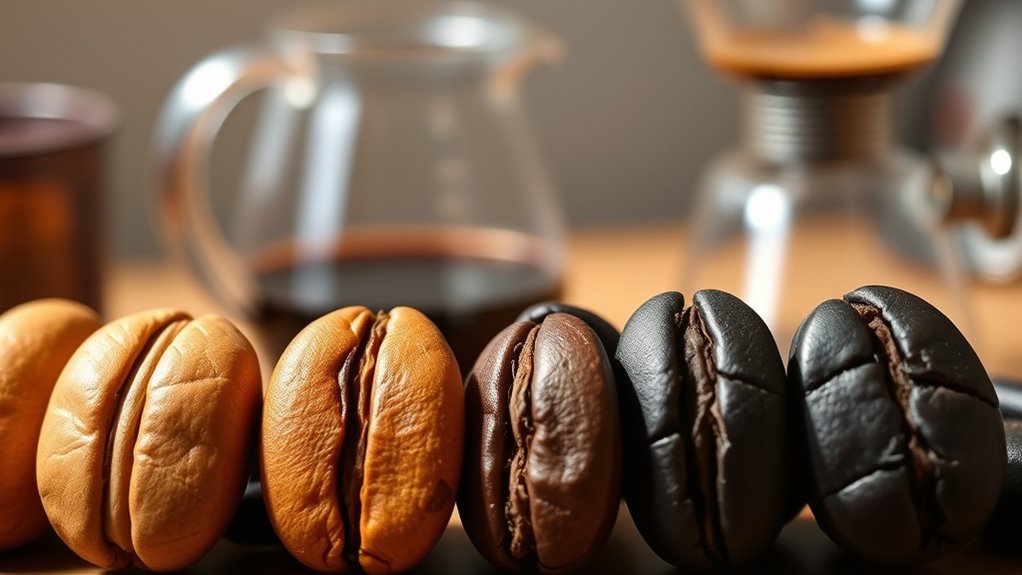
Coffee acidity, often described as brightness or a lively tang, is more prominent in lighter roasts. Lighter roasts retain more of the coffee bean’s original characteristics, including fruity and floral notes, which contribute to a higher acidity level. As a result, if you prefer a vibrant, crisp cup, you’ll want to consider a lighter roast and optimize your brewing temperature accordingly. Brewing temperature plays a significant role here because it affects how these delicate acids are extracted. Generally, hotter water extracts more of these acids, emphasizing brightness, while cooler temperatures can mellow the acidity, producing a softer flavor profile.
Lighter roasts highlight fruity and floral notes, with brewing temperature influencing acidity and brightness.
When brewing, it’s crucial to find the right temperature that complements your roast level. For lighter roasts, using water around 195–205°F (90–96°C) allows you to extract the full spectrum of flavors, including the lively acidity. If your brewing temperature is too high, you risk over-extracting, which can lead to bitterness and a loss of clarity. Conversely, too low a temperature might under-extract, leaving the coffee flat and underscoring the importance of precision. With darker roasts, which tend to have a more subdued acidity, you might use slightly higher temperatures or different brewing methods to bring out underlying smoky or chocolate notes without accentuating acidity.
Your choice of brewing temperature also affects how other variables work together, such as grind size and brew time. For instance, a finer grind combined with a high brewing temperature can lead to over-extraction, making the coffee bitter. On the other hand, a coarser grind with a lower temperature might result in under-extraction and weak flavor. By understanding these relationships, you can tailor your brewing process to suit your preferred roast level and flavor profile.
Additionally, considering the fiber content of coffee can influence how you adjust your brewing variables, as it impacts the extraction process and final flavor. In the end, mastering the interaction between roast levels, coffee acidity, and brewing temperature empowers you to craft a more personalized, balanced cup every time. Adjusting these variables allows you to highlight the best qualities of each roast and achieve a harmonious flavor that matches your taste. Whether you love the bright sparkle of a light roast or the deep richness of a dark one, understanding how these elements interact is your key to coffee perfection.
As an affiliate, we earn on qualifying purchases.
Frequently Asked Questions
How Do Roast Levels Affect Coffee Acidity?
You’ll notice that darker roasts tend to have less acidic flavor, while lighter roasts preserve more of the coffee’s natural acidity. This is because the roast profile influences the acidity level; as beans are roasted longer, acids break down, resulting in a smoother, less tangy taste. So, if you prefer a bright, lively coffee, opt for a lighter roast, and if you enjoy a mellow, less acidic brew, go darker.
What Brewing Method Best Suits Dark Roasts?
You should use espresso extraction for dark roasts because it highlights their bold, intense flavors and balances their natural bitterness. Pour-over techniques also work well, allowing you to control extraction time and temperature, which enhances the rich, smoky notes. Both methods bring out the best in dark roasts, giving you a full-bodied, flavorful cup. Experiment to find which method suits your taste preferences best.
Can Brewing Variables Compensate for Roast Level Differences?
Think of brewing variables as your secret toolbox—yes, they can help bridge the gap caused by roast level differences. You can tweak brew temperature and water chemistry to enhance flavor, balance acidity, or smooth out bitterness. For instance, lowering the brew temperature might soften a dark roast’s boldness, while adjusting water chemistry can brighten or mellow the taste. So, with the right tweaks, you can make any roast sing.
How Does Grind Size Change With Roast Level?
You should adjust your grind size based on the roast level to maintain brew consistency. Darker roasts generally need a slightly coarser grind because their beans are more brittle, which can lead to over-extraction if ground too fine. Lighter roasts benefit from a finer grind to extract more flavor. Making these grind size adjustments helps you achieve a balanced extraction and consistent taste across different roast levels.
Are Lighter Roasts More Caffeine-Rich Than Darker Ones?
Lighter roasts are generally more caffeine-rich than darker ones because they preserve more caffeine during roasting. When you brew, the caffeine extraction from lighter roasts tends to be slightly higher, giving you a more energizing cup. Plus, lighter roasts retain more of their original flavor, so you get a richer taste experience. If you’re after a caffeine boost with vibrant flavors, lighter roasts are your best choice.
Conclusion
Understanding roast levels and brewing variables helps you craft the perfect cup. Did you know that darker roasts typically have 20% less caffeine than lighter ones? So, if you’re chasing a caffeine boost, a lighter roast might be your best bet. By experimenting with these factors, you’ll find your ideal flavor profile and enjoy each sip even more. Keep exploring, and soon you’ll master the art of brewing coffee tailored just for you.